Mustard greens Nutrition facts
Peppery, crispy mustard greens, also known as leaf mustards, are indeed one of the most nutritious green leafy vegetables available in the winter months. Its lovely top greens, indeed, possess more vitamin A, K, carotenes, and flavonoid antioxidants than some of the typical fruits and vegetables.
The crispy, leafy tops gathered from the mustard plant while it is small, tender, and short of reaching the flowering stage. Leaf-mustards belongs to the Brassica family, which also includes cabbage, broccoli, brussels sprouts, etc. Scientific name: Brassica juncea.
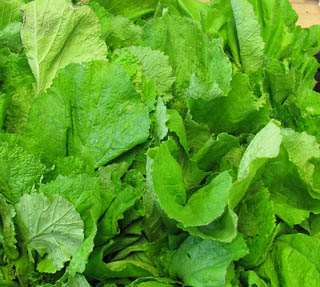 |
| Mustard greens. Note for the bright green broad leaves with serrated margins. (Photo: nataliemaynor) |
The mustard plant is native to sub-Himalayan plains of the Indian sub-continent, commonly cultivated for its leaves and oil seeds since ancient times. Mustards are cool-season winter crops. Their tender, crispy leaves are more flavorful and last from November until March.
|
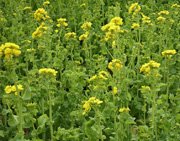
| Mustard plant in a farm field. Note for bright yellow flowers. (Photo: itchys |
Several cultivars of leaf mustards exist. Normally, its young tender greens that are meant to be used as green-leafy vegetables gathered when the plant reaches about 2 feet tall. If left alone, it continues to grow in height and bears golden-yellow flowers that subsequently develop into mustard seed pods.
Fresh mustard leaves feature deep green, broad leaves with a flat surface and may have either toothed, frilly, or lacy edges depending on the cultivar type. Its light-green stem branches out extensively into many laterals.
Mizuna or Japanese mustard (Brassica rapa subsp. nipposinica) is a close cultivar type in the Brassica rapa group of leafy greens.
Mustard seeds are extensively used as a condiment spice in cooking, as well as in cooking oil production in many parts of South-Asian regions.
Health benefits of Mustard greens
Mustard greens, like spinach, are the storehouse of many phytonutrients that have health promotional and disease prevention properties.
Leaf-mustard is very low in calories (27 calories per 100 g raw leaves) and fats. However, its dark green leaves carry ample amounts of phytonutrients, vitamins, and minerals. Additionally, it contains a very good amount of dietary fiber that helps control cholesterol levels by interfering with its absorption in the gut. Adequate fiber in the food aids in smooth bowel movements and thereby offers protection from hemorrhoids, constipation and colon cancer diseases.
The greens are excellent sources of vitamin-K. 100 g of fresh leaves carry about 257.5 µg or about 215% of the daily requirement of vitamin K-1 (phylloquinone). Vitamin K has been found to have a potential role in bone mass-building function by promoting osteoblastic activity in the bone. It also has an established role to play in Alzheimer's disease patients by limiting neuronal damage in their brain.
Mustard greens are a rich source of antioxidants like flavonoids, indoles, sulforaphane, carotenes, lutein, and zeaxanthin. Indoles, mainly Di-indolyl-methane (DIM) and sulforaphane have proven benefits against prostate, breast, colon and ovarian cancers by virtue of their cancer-cell growth inhibition, cytotoxic effects on cancer cells.
Fresh leaves are also a modest source of the B-complex group of vitamins such as folic acid, pyridoxine, thiamin, riboflavin, etc. 100 g fresh leaves provide about 12 µg (about 3% of RDA) of folic acid. This water-soluble vitamin has a significant role in DNA synthesis and cell division. When supplemented by women during their peri-conception time, this vitamin may help prevent neural tube defects in their newborn babies.
Fresh mustard leaves are excellent sources of vitamin C. 100 fresh leaves provide 70 µg or about 117% of RDA. Vitamin C (ascorbic acid) is a powerful natural antioxidant that offers protection against free radical injury and flu-like viral infections.
Mustard leaves are also incredible sources of vitamin-A (provide 3024 IU or 101% of RDA per 100 g). Vitamin A is an essential nutrient required for maintaining healthy mucosa and skin. Consumption of natural fruits rich in flavonoids helps protect from lung and oral cavity cancers.
Fresh mustard greens are an excellent source of several essential minerals such as calcium, iron, magnesium, potassium, zinc, selenium, and manganese.
Regular consumption of mustard greens in the diet is known to prevent arthritis, osteoporosis, and iron deficiency anemia and is believed to offer protection from cardiovascular diseases, asthma, and colon and prostate cancers.
| Principle | Nutrient Value | Percent of RDA |
|---|---|---|
| Energy | 27 Kcal | 1% |
| Carbohydrates | 4.67 g | 3.6% |
| Protein | 2.86 g | 5% |
| Total Fat | 0.42 g | 2% |
| Cholesterol | 0 mg | 0% |
| Dietary Fiber | 3.20 g | 9% |
| Vitamins | ||
| Folates | 12 µg | 3% |
| Niacin | 0.800 mg | 5% |
| Pantothenic acid | 0.210 mg | 5% |
| Pyridoxine | 0.180 mg | 14% |
| Riboflavin | 0.110 mg | 8% |
| Thiamin | 0.080 mg | 7% |
| Vitamin A | 3024 IU | 101% |
| Vitamin C | 70 mg | 117% |
| Vitamin E | 0 mg | 0% |
| Vitamin K | 257.5 µg | 215% |
| Electrolytes | ||
| Sodium | 20 mg | 1.3% |
| Potassium | 384 mg | 8% |
| Minerals | ||
| Calcium | 115 mg | 11.5% |
| Copper | 0.165 mg | 18% |
| Iron | 1.64 mg | 20% |
| Magnesium | 32 mg | 8% |
| Manganese | 0.480 mg | 21% |
| Selenium | 0.9 µg | 1.5% |
| Zinc | 0.25 mg | 2% |
| Phyto-nutrients | ||
| Carotene-ß | 1790 µg | -- |
| Crypto-xanthin-ß | 40 µg | -- |
| Lutein-zeaxanthin | 3730 µg | -- |
Selection and storage
Mustards are winter crops. In the markets, look for fresh mustard greens featuring crispy, dark-green leaves that should show vitality. Avoid sunken, spotted, or yellow, discolored leaves.
Its leaves wilt soon if kept at room temperature; therefore, should be stored in the refrigerator immediately. Although they can be kept for up to three days in cold storage, fresh mustard greens should be used as early as possible to get maximum nutrients.
Preparation and serving methods
|
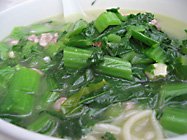
| Mustard green soup, a Chinese delicacy. (Photo: by taste-buzz) |
Fresh mustard leaves, flower buds, and stems can be used in a variety of cuisines all over Asia and in Eastern Europe.
Before cooking, wash its leaves thoroughly in clean running water to remove sand and soil, and then rinse in saline water for about 30 minutes in order to remove surface dirt, and any insecticide residues. Trim away thick petioles and stems.
Here are some serving tips:
Fresh tender mustard greens can be eaten raw in salads and can be juiced with other greens and vegetables.
- In South Asian cuisines, mustard is generally stew fried or steam cooked and mixed with other greens such as spinach, fenugreek, etc. Its pungent, peppery flavor is somewhat tamed by adding butter, tomato, garlic and onion to the recipes.
It also complements well with ham, pork, and bacon in cooking.
Safety profile
As in spinach, reheating mustard green leftovers may cause the conversion of nitrates to nitrites and nitrosamines by certain bacteria that thrive on prepared nitrate-rich foods. These toxic compounds may be harmful to health.
High phytate and dietary fiber content in mustard greens may interfere with the bioavailability of iron, calcium, and magnesium.
Because of its high vitamin-K content, patients taking anti-coagulants such as warfarin are encouraged to avoid this food since it increases the vitamin-K concentration in the blood, which is what the drugs are often attempting to lower. This may advertently raise the effective dose of the drug.
Mustards contain oxalic acid, a naturally occurring substance found in some vegetables, which may crystallize as oxalate stones in the urinary tract in some people. It is, therefore, people with known oxalate urinary tract stones are encouraged to avoid eating vegetables belonging to the Brassica family.
Mustard greens may also contain goitrogens, which may interfere with thyroid hormone production and can cause thyroxin hormone deficiency in individuals with thyroid dysfunction.
(Medical Disclaimer: The information and reference guides on this website are intended solely for the general information of the reader. It is not to be used to diagnose health problems or for treatment purposes. It is not a substitute for medical care provided by a licensed and qualified health professional. Please consult your health care provider for any advice on medications.)
You may also like to read >>-
≻≻-Mizuna nutrition facts.
≻≻- Broccoli rabe Health benefits.
≻≻- Komatsuna (Japanese mustard spinach) Health benefits.
≻≻-Back to Vegetables from Mustard greens nutrition. Visit here for an impressive list of vegetables with complete illustrations of their nutrition facts and health benefits.
≻≻-Back to Home page.
Further reading:
Refer Stanford School of Medicine Cancer information Page- Nutrition to Reduce Cancer Risk (Link opens in new window).