Epazote Nutrition facts
Epazote is a traditional Central American herb employed by native Mexicans since antiquity. Its strong, musky flavor gives a unique taste to Mexican and other Latin American cuisines. While its young shoots and tender leaves are used like leafy greens in soups; its mature, pungent leaves are added in small quantities as digestive and carminatives in bean, fish, and corn dishes.
Binomially, the herb belongs to the large Amaranthaceae family of herbs and vegetables, including amaranth, spinach, quinoa, beets, etc. Scientific name: Chenopodium ambrosioides. Some of the common names include wormseed, Mexican tea, pazote, etc.
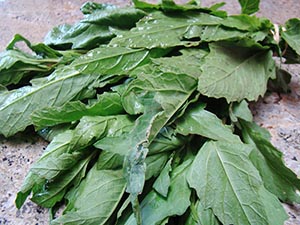 |
| Epazote (Chenopodium ambrosioides). Note for serrated, pointed green leaves. Courtesy: jonny.hunter |
Epazote is one of the most efficiently growing annual herbs. It prefers well-draining, sandy soil and full sunlight to flourish. The herb grows generously in the fields and on the roadside hedges as a weedy invasive plant. It reaches about 60 to 100 cm in height featuring small pointed leaves with serrated margins. Tiny yellow-green flowers appear in clusters as in amaranth, which develop subsequently into numerous small black seeds.
Health benefits of Epazote
Epazote has largely been viewed as a medicinal herb rather than a potherb. Normally its leaves are used in cooking to counter the indigestion and flatulence effects of foods prepared with protein-rich, high-fiber beans. Nonetheless, it has its own inherent phytonutrients, which when consumed in moderation, would contribute towards overall wellness.
The herb is very low in calories. 100 grams of leaves carry just 32 calories. Its smooth leaves provide a good amount of fiber, 3.8 g per 100g.
Its leaves are composed of many monoterpene compounds such as ascaridole (60-80%), iso-ascaridole, p-cymene, limonene, and terpinene. Ascaridole is toxic to several intestinal worms like roundworms, hookworms, pinworms, etc. Native Mayans drank its infusion regularly to keep off from worm infestation.
The herb parts, especially young leaves are an excellent source of folic acid, providing 215 µg or 54% of daily recommended values. Folic acid is involved in the DNA synthesis and cell division.Caution note: Expectant mothers, however, should avoid epazote greens in their diet since it causes uterine cramps and possible risk of termination of pregnancy. (Medical disclaimer).
Epazote has small amounts of vitamin-A and some flavonoid phenolic anti-oxidants such as beta-carotenes. Together, they act as protective scavengers against oxygen-derived free radicals and reactive oxygen species (ROS) that play a role in aging and various disease processes.
The herb has a good amount of minerals like calcium (27% of RDA), manganese, potassium, iron, copper, zinc, and selenium. The body uses manganese as a co-factor for the antioxidant enzyme, superoxide dismutase.
It has small but adequate levels of other B-complex vitamins, particularly pyridoxine and riboflavin. These vitamins function as co-factors in the enzymatic metabolism inside the body.
| Principle | Nutrient Value | Percent of RDA |
|---|---|---|
| Energy | 32 Kcal | 1.5% |
| Carbohydrates | 7.44 g | 6% |
| Protein | 0.33 g | <1% |
| Total Fat | 0.52 g | 2% |
| Cholesterol | 0 mg | 0% |
| Ditary fiber | 3.8 g | 10% |
| Vitamins | ||
| Folates | 215 µg | 54% |
| Niacin | 0.639 mg | 4% |
| Pantothenic acid | 0.179 mg | 3.5% |
| Pyridoxine | 0.152 mg | 12% |
| Riboflavin | 0.348 mg | 27% |
| Thiamin | 0.028 mg | 2% |
| Vitamin A | 57 IU | 2% |
| Vitamin C | 3.6 mg | 6% |
| Electrolytes | ||
| Sodium | 80 mg | 5% |
| Potassium | 470 mg | 10% |
| Minerals | ||
| Calcium | 275 mg | 27.5% |
| Copper | 0.190 mg | 21% |
| Iron | 1.88 mg | 24.5% |
| Magnesium | 121 mg | 30% |
| Manganese | 3.098 mg | 135% |
| Phosphorus | 86 mg | 12% |
| Selenium | 0.9 µg | 1% |
| Zinc | 1.10 mg | 10% |
| Phytonutrients | ||
| Carotene-ß | 38 µg | -- |
Selection and storage
Epazote is available year-round in the stores specializing in Latin American herbs. One may also find dried leaves in the spice stores.
While buying the herb, look for fresh, small, young tender leaves as mature leaves can be pungent and strongly scented. Avoid large, flower stems with yellow or wilted leaves. Once at home, store unwashed in the refrigerator as other greens, wrapped in a damp towel.
Preparation and serving methods:
Epazote has a strong pungent flavor with a hint of petroleum and mint smell dominating. Its leaves, fresh or dried, and young shoots are being used as a seasoning in dishes in Mexican, Chilean, and other South American regions.
To prepare, wash the leaves in cold water as in other greens and herbs. A few leaves or 1-2 sprigs are just enough to flavor the whole food. It is mainly added to the traditional black bean recipes to improve digestion.
Here are some cooking tips:
|
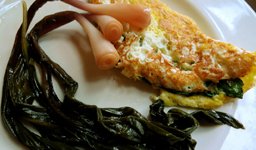
| Epazote omelet with pickled ramp. Photo courtesy: yuco chan |
Fresh epazote leaves added to flavor corn-based recipes like gordita (corn dumplings) and bocoles (cornmeal cakes).
The herb is used in traditional Mexican mole sauce with other ingredients like tomato, bell pepper, tomatillo, annatto, etc.
Fresh leaves used in black (Frijoles negros) and pinto bean stews.
Contrary to its name, Epazote herb is not used to make tea but to make an herbal infusion which is later used in the recipes. Traditional Yucatan lime and chicken soups use this decoction.
Quesadillas con Epazote, is a cheese-stuffed tortilla that uses the herb as one of the ingredients along with potatoes, mushrooms, egg, etc.
Medicinal uses of epazote herb
Epazote has been found in traditional medicines in many Central and South American cultures. Its infusion is a popular household remedy for helminthic infestation. Usually, a half-to-one cup of a leaf decoction is given each morning before the meal for three consecutive days as treatment.
The herb is an excellent remedy for stomach and intestinal ailments like indigestion, cramps, and ulcers.
Its decoction has been found to have some anti-diabetic properties. Further, certain trial studies suggest it holds hope for some liver cirrhosis and cancers.
The herb parts should not be included in the nursing and pregnant mothers for their possible toxic effects. (Medical disclaimer).
Safety profile
Important: Epazote herb parts should not be consumed by nursing and pregnant mothers for their possible toxic effects. (Medical disclaimer).
Epazote (wormseed) should be used in small quantities. Its seed oil contains a large concentration of ascaridole and other monoterpenes. When taken internally, these chemicals in the oil may cause extensive damage to the liver, and kidneys, and cause rhythm disturbances in the heart and nervous systems. For the same reason, wormseed oil is banned by IFRA (International Fragrance Association) for both external and internal use of its products.
≻≻-Back to Herbs from Epazote. Visit here for an impressive list of all varieties of herbs with complete illustrations of their nutrition facts and health benefits.
≻≻-Back to Home page.
Further Resources:
Tropical plant database- Chenopodium ambrosioides.
Epazote-Fact sheet