Bok choy Nutrition facts
Bok choy, also known as leafy Chinese-cabbage, is one of the popular vegetables in mainland China, the Philippines, Vietnam, and other East-Asian regions. At the same time, this humble Brassica family leafy-vegetable has captured the attention of the Western world for its sweet, succulent nutritious leaves and stalks.
Scientific name: Brassica campestris L. (Chinensis group). Several local dialects for it in the East-Asian countries are 上海青, pe-tsai, pak choi, petsay, white-celery mustard, Chinese white cabbage…etc.
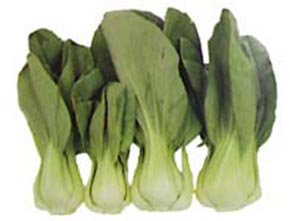 |
| Bok choy. Note for small, upright, cylindrical stems with dark green leaves. |
In structure, bok choy resembles collards and could be described as a non-heading cabbage (Acephala group). It is a small plant that grows upright from the ground surface with smooth white romaine lettuce like stalks, which spread at its top to fine, glossy green, oval, or round leaves. Fully grown-up bok choy may reach about 12-18 inches in height.
Brassica campestris group can be further categorized according to the color of petioles in its leaves as:
White petioled; varieties include joi choi, pak-choy white, prize choi, lei choi, taisai, canton pak choi…etc.
Green petioled types are Chinese pak choi green, mei qing choi…etc.
Health benefits of Bok choy
Bok choy is one of the popular low-calorie leafy vegetables. Nonetheless, it is a very rich source of many vital phytonutrients, vitamins, minerals, and health-benefiting antioxidants.
100 grams of bok choy carries just 13 calories. It is one of the recommended vegetables in the weight-reduction programs falling under the "zero calorie or negative calorie" category of food items, which when eaten would add no extra calories to the body but facilitate calorie (fat) burn and thereby bring a reduction in the body weight.
As in other Brassica family vegetables, bok choy also contains certain antioxidant plant chemicals such as thiocyanates, indole-3-carbinol, lutein, zeaxanthin, sulforaphane, and isothiocyanates. Together with dietary fiber and vitamins, these compounds help protect against breast, colon, and prostate cancers and help reduce LDL or "bad cholesterol" levels in the blood.
Fresh pak choi is an excellent source of water-soluble antioxidant, vitamin-C (ascorbic acid). 100 g provides 45 mg or 75% of the daily requirements of vitamin C. Regular consumption of foods rich in vitamin C helps the body develop resistance against infectious agents and scavenge harmful, pro-inflammatory free radicals from the body.
Bok-choy has more vitamin-A, carotenes, and other flavonoid polyphenolic anti-oxidants than cabbage, cauliflower, etc. Just 100 g of fresh leaves provide 4468 IU or 149% of daily-required levels vitamin A.
Pak choi is an excellent source of vitamin K, provides about 38% of RDA levels. Vitamin K has a potential role in bone metabolism by promoting osteoblastic activity inside bone cells. Hence, enough vitamin K in the diet makes bone stronger, and healthier and delay osteoporosis. Further, vitamin K also has been found to have an established role in curing Alzheimer's disease patients by limiting neuronal damage in their brains.
Fresh bok choy is a vital source of B-complex vitamins such as pyridoxine (vitamin B6), riboflavin, pantothenic acid (vitamin B5), pyridoxine, and thiamin (vitamin B-1). These vitamins are essential in the sense that our body requires them from external sources to replenish.
Further, this leafy vegetable is a moderate source of minerals, particularly calcium, phosphorous, potassium, manganese, iron, and magnesium. Potassium is an important electrolyte inside the cells and body fluids that help regulate heart rate and blood pressure. The human body uses manganese as a co-factor for the antioxidant enzyme, superoxide dismutase. Iron is required for red blood cell formation.
| Principle | Nutrient Value | Percent of RDA |
|---|---|---|
| Energy | 13 kcal | <1% |
| Carbohydrates | 2.18 g | 1.5% |
| Protein | 1.5 g | 3% |
| Total Fat | 0.20 g | 1% |
| Cholesterol | 0 mg | 0% |
| Dietary Fiber | 1 mg | 2.5% |
| Vitamins | ||
| Folates | 66 µg | 16% |
| Niacin | 0.500 mg | 3% |
| Pantothenic acid | 0.088 mg | 1.5% |
| Pyridoxine | 0.194 mg | 15% |
| Riboflavin | 0.070 mg | 5% |
| Thiamin | 0.040 mg | 3.5% |
| Vitamin A | 4468 IU | 149% |
| Vitamin C | 45 mg | 75% |
| Vitamin K | 45.5 µg | 38% |
| Electrolytes | ||
| Sodium | 65 mg | 4% |
| Potassium | 252 mg | 5% |
| Minerals | ||
| Calcium | 105 mg | 10.5% |
| Iron | 0.80 mg | 10% |
| Magnesium | 19 mg | 5% |
| Manganese | 0.159 mg | 7% |
| Phosphorus | 37 mg | 5% |
| Zinc | 0.19 mg | 1.5% |
| Phyto-nutrients | ||
| Carotene-α | 1 µg | -- |
| Carotene-ß | 2681 µg | -- |
| Lutein-zeaxanthin | 40 µg | -- |
Selection and storage
Although bok choy can be available year-round, it is at its best during the winter season. In the markets, buy fresh harvest featuring firm stalks and dark green crispy, flavorful leaves. Avoid slump plants with leaves wilted and lost their luster.
Once at home store whole pak choi (bok-choy) in a vegetable compartment inside the refrigerator, set at high relative humidity. If stored appropriately, it stays fresh for up to 3-4 days without loss of nutrients. However, pak choi is more nutritious, sweeter, and flavorful when used fresh.
Preparation and serving methods
Trim off at its base and remove discolored outer leaves. Wash it in cold water. Gently pat dry or place it upside down until all the water drains out.
To prepare, separate the outer stalks from the base using a paring knife and divide the whole plant into halves lengthwise. Then, chop off from the stem end about an inch apart and work towards its leafy top. Add it to a variety of recipes, either combined with other vegetables or enjoy all alone in stir-fry or soup.
Here are some of the preparation tips:
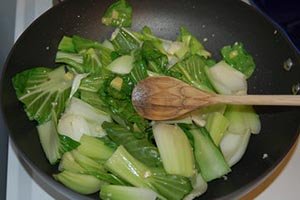 |
| Bok choy stir-fry with ginger, garlic, soy sauce, and a bit of chili paste. Courtesy: Scott |
Crispy, sweet bok choy stalks can be eaten raw, and added to salads, sandwiches, and burgers.
Its stalks can be mixed well with cabbage in coleslaw.
Baby bok choy can be a very attractive addition to salads and stir-fries.
Pechay-ginisang (sauteed bok choy) is a popular stir-fry dish among Filipinos.
In the Korean peninsula, it is employed much like napa cabbage in the preparation of "bok-choy kimchi".
In China and other East Asian regions, it is used much like cabbage in stew fries with added onion, garlic, bell pepper, and green chilies mixed with steamed rice and soy/chili/tomato sauce to prepare chowmein (Chaomiàn).
Pak choi is one of the wonderful vegetables used generously in modern-day recipes like stir-fries, soups, and stuffings.
It complements well with cabbage, chilies, capsicum, onion, ginger, garlic, rice, tofu, seafood, meat and poultry.
Safety profile
Like in cabbage, bok choy also contains certain chemical compounds known as "goitrogens." These plant-based compounds are found abundantly in Brassica/cruciferous vegetables like cauliflower and broccoli. Prolonged consumption of vegetables high in goitrogens may lead to swelling of the thyroid gland, a condition known as goiter. It is, therefore, advised that some individuals with thyroid dysfunction limit the consumption of brassica family vegetables in their food. However, they may be consumed without any reservations by healthy individuals. (Medical disclaimer).
Also read ≻≻-
≻≻- Napa cabbage nutrition facts.
≻≻- Komatsuna nutrition facts.
≺≺ Tatsoi (Tai cai (塌菜)) Nutrition facts.
≻≻- Cabbage nutrition facts.
≻≻- Back to Vegetables from Bok Choy. Visit here for an impressive list of vegetables with complete illustrations of their nutrition facts and health benefits.
≻≻- Back to Home page.
Further Reading:
Chinese cabbage-Agri life extension-Texas A&M Sysstem.-pdf.
USDA National Nutrient Database.