Horseradish Nutrition facts
Horseradish is a pungent, long, tapering root that is employed as a condiment to the recipes. It possesses a strong, hot, and sharp flavor which can only be appreciated after experiencing its unique taste!
Botanically, this spicy root belongs to the genus, Armoracia, in the Brassicaceae (mustards) family; sharing with other members of Brassica like mustard, kale, radish, cabbage, etc.
Scientific name: Armoracia rusticana.
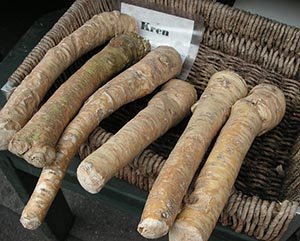 |
| Horseradish root. Note for long, coarse, tapering roots with rusty brown peel and white flesh. Photo courtesy: fooding around |
Horseradish is native to the Eastern and Mediterranean regions of Europe, from where it spread to the Americas during colonial times.
Armoracia rusticana is a small perennial herb but can grow as an annual field crop for its thick, rough, fleshy roots in many parts of Germany, the USA, England, Hungary, Japan, and China.
|
| Wasabi root. |
A. rusticana plant features broad, crinkled leaves. It grows best in cool climates with adequate sunlight conditions. In general, the rootlets (root sections) are planted in the spring for harvest by autumn. It measures about 6-12 inches long with a few round knots at the root end. The fresh root has a rough, gray-brown outer surface.
Wasabi (Wasabia japonica) is a Japanese variant of horseradish but has a more intense and stronger flavor. Inside, it features delicate apple-green color flesh.
8 Amazing Health Benefits of Horseradishes
Horseradish is low in calories and fat. However, it contains good amounts of dietary fiber, vitamins, minerals, and antioxidants. Certain active principles in it were found to have been anti-inflammatory, diuretic (increase urine output), and soothing effects.
The root contains many volatile phytochemical compounds, which give it a much-famed biting character. Some of the major constituents in the root are allyl isothiocyanate, 3-butenyl isothiocyanate, 2-propenyl glucosinolate (sinigrin), 2-pentyl isothiocyanate, and phenyl ethyl isothiocyanate. It has been found that these compounds have been known to carry antioxidant and detoxification functions.
Some of the volatile phytochemical compounds in the root stimulate the secretion of salivary, gastric, and intestinal digestive enzymes, and thereby facilitate digestion. It thus works as a potent gastric stimulant that increases appetite.
Horseradish has good amounts of vitamin-C, which is a powerful water-soluble antioxidant. 100 g fresh root holds 29 mg or 41% of daily recommended values.
Vitamin C helps alleviate viral infections by boosting immunity. Also, it helps remove harmful free radicals from the body and may help protect it from cancers, inflammation, and infections.
This root spice has some of the vital minerals in moderation like sodium, potassium, manganese, iron, copper, zinc, and magnesium. Iron is an essential co-factor for cytochrome oxidase enzymes during cellular metabolism. It is also required for red blood cell production in the bone marrow.
Potassium, being an important component of cell and body fluids, helps control heart rate and blood pressure. Manganese is used by the human body as a co-factor for the powerful antioxidant enzyme, superoxide dismutase.
Besides, the root has small amounts of essential vitamins such as folate, vitamin B-6 (pyridoxine), riboflavin, niacin, and pantothenic acid.
| Principle | Nutrient value | Percent of RDA |
|---|---|---|
| Energy | 48 cal | 2% |
| Carbohydrates | 11.29 g | 9% |
| Protein | 1.18 g | 2% |
| Total Fat | 0.69 g | 3% |
| Cholesterol | 0 mg | 0% |
| Dietary Fiber | 3.3 g | 9% |
| Vitamins | ||
| Folates | 57 µg | 14% |
| Niacin | 0.386 mg | 2.5% |
| Pantothenic acid | 0.093 mg | 2% |
| Pyridoxine | 0.073 mg | 6% |
| Riboflavin | 0.024 mg | 2% |
| Thiamin | 0.008 mg | <1% |
| Vitamin A | 2 IU | <1% |
| Vitamin C | 24.9 mg | 41% |
| Electrolytes | ||
| Sodium | 314 mg | 21% |
| Potassium | 246 mg | 5% |
| Minerals | ||
| Calcium | 56 mg | 6% |
| Copper | 0.058 mg | 6% |
| Iron | 0.42 mg | 5% |
| Magnesium | 27 mg | 7% |
| Manganese | 0.126 mg | 5.5% |
| Phosphorus | 31 mg | 4.5% |
| Zinc | 0.83 mg | 8% |
| Phyto-nutrients | ||
| Carotene-ß | 1 µg | -- |
| Crypto-xanthin-ß | 0 µg | -- |
| Lutein-zeaxanthin | 10 µg | -- |
Selection and storage
Horseradish root is harvested by late fall when its leaves are killed by the frost. You may also want to buy fresh roots from the markets during this season.
Select fresh, stony hard root that is devoid of sprouts, mold, or soft spots. Avoid green-tinged roots, as they are very bitter. Also, avoid overmature, old, and larger roots, as they tend to be excessively fibrous and thus, off-flavored.
Once at home, store the root in a loose paper pack and place it in the refrigerator where it will remain dormant for the next 6-9 months. Commercially prepared horseradish products can be readily available in stores all around the year.
Preparation and serving methods
Fresh root has a beige exterior color. Clean it using a moist cloth to remove surface dirt as you do it for ginger. Wash gently in cold water and mop it dry. Cut the root from the tip end as much part as you may require for your family that should last for 2-3 days. Keep the unused root inside a loosely wrapped plastic bag in the refrigerator to prevent it from drying out.
To prepare, freshly grated horseradish root is mixed with white vinegar in a desired manner to control (stabilize) its hotness. This preparation, however, gradually loses its flavor with time and turns off-white to brown color even if you keep it in cold storage.
The pungency and hotness of horseradish may not be appreciable in the whole root. However, crushing or grating the root (as in onion and radish,) releases the volatile allyl-isothiocyanate compound that can cause irritation to eyes, skin, mucosa of nose, and throat.
Vinegar or citric acid neutralizes pungency and stabilizes its flavor. Add 2 to 3 tablespoons of white vinegar and 1/2 teaspoon of table salt to one cup of grated horseradish. If you desire a milder taste, then add vinegar 1-2 minutes later.
Like in many other spices, horseradish also loses its flavor instantly. To keep the fragrance and flavor intact, it is grated just before preparing dishes and added to the cooking recipes in the final stages.
Here are some serving methods:
|
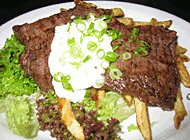
| Steak with horseradish cream and french fries. Photo: jeffreyallen |
Horseradish is one of the traditional spices that is relished even today in the countryside. Fresh root grated directly on the recipes to add special jest.
The root is used in many preparations, including dips, dressings, salads, and sauces as an accompaniment to meat, chicken, and seafood.
Horseradish sauce with cream is a perfect accompaniment to steak, venison, and fish like mackerel, tuna, and smoked trout.
Safety profile
Horseradish can cause irritation to skin, mucosa, and eyes. It is due to the release of allyl sulfide gas (allyl-isothiocyanate) while chopping, crushing, or grating the root. Disruption of the cell wall activates the enzyme myrosinase which when reacts with glucosinolates to form allyl isothiocyanates. Lemon citrus or vinegar stops this reaction and stabilizes the flavor. Its effect can be minimized by using a blender/mixer in a well-ventilated place and wearing protective gloves and a mask. (Medical disclaimer).
You may also like to read ≻≻-Wasabi nutrition facts and Health benefits..
≻≻-Back to Spices from Horseradish. Visit here for an impressive list of healthy spices with complete illustrations of their nutrition facts and health benefits.
≻≻-Back to Home page.
Further reading:
Horseradish Information Council. (opens in a new window).