Ginger root nutrition facts
Ginger root nutrition facts
Pungent, spicy ginger root is one of the traditional root herbs of culinary and medicinal importance. Ginger composes novel phytochemical compounds and holds a special place, even today, in many traditional Indian and Chinese medicines for their disease-preventing and health-promoting properties.
<The spicy root is actually a subterranean rhizome of a small herb plant belonging to the Zingiberaceae family, of the genus: Zingiber.
Scientific name: Zingiber officinale.

|
|
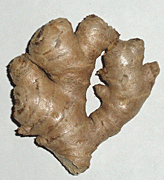
| Ginger herb. | Fresh ginger root. Note for the knobby surface. |
Ginger is thought to have originated in the Himalayan foothills of Northern India. Today, it is widely grown all over the world as a major commercial spice crop. The ginger plant grows to about a meter in height and features thin grass blades like dark-green leaves and small yellow flowers.
Its root features knotty finger-like projections that grow downward from the soil surface. The fresh root has a silver-gray outer skin (peel). Cut sections feature creamy white, yellow, or red-colored crunchy flesh depending upon the variety. The root often contains thin strands of fibrils running lengthwise through its center, especially in overmature ones.
Ginger has a pungent, spicy, and aromatic smell that comes from essential oils and phenolic compounds such as gingerols and shogaols in the root.
Galangal (Alpinia galanga), also known as "blue ginger," is a closely related herb that is used extensively in East Asian regions, especially in Thailand, Malaysia, and Indonesian cuisine. Galangal has a mild, subtle flavor and is less pungent than ginger.
Health benefits of Ginger
Ginger root has been in use since ancient times for its anti-inflammatory, carminative, anti-flatulent, and anti-microbial properties. Total antioxidant strength measured in terms of oxygen radical absorbance capacity (ORAC) of ginger root is 14,840 µmol TE/100 g.
It contains health benefiting essential oils such as gingerol, zingerone, shogaol, farnesene, and small amounts of ß-phelladrene, cineol, and citral. Gingerols help improve intestinal motility and have anti-inflammatory, painkiller (analgesic), nerve soothing, antipyretic as well as anti-bacterial properties. Studies have shown that it may decrease nausea induced by motion sickness or pregnancy and may help relieve a migraine headache.
Studies suggest that zingerone, a chemical compound which gives pungent character to the ginger root, is effective against E.coli induced diarrhea, especially in children.
This herb root only has 80 calories per 100 g and contains no cholesterol. Nonetheless, it composes many essential nutrients and vitamins such as pyridoxine (vitamin B-6), and pantothenic acid (vitamin B-5) that are required for optimum health.
Furthermore, it also holds a good amount of minerals like potassium, manganese, copper, and magnesium. Potassium is an important component of cells and body fluids that helps control heart rate and blood pressure.
Medicinal uses
Ginger root slices, boiled in water with lemon or orange juice, and honey, is a popular herbal drink in Ayurvedic medicine to relieve common cold, cough, and sore throat.
Its extraction is used as a vehicle to mask bitterness and aftertaste in traditional Ayurvedic preparations.
Gingerols increase the motility of the gastrointestinal tract and have analgesic, sedative, anti-inflammatory, and antibacterial properties. Studies have shown that it may help reduce nausea caused by motion sickness or pregnancy and may help relieve a migraine.
| Principle | Nutrient Value | Percent of RDA |
|---|---|---|
| Energy | 80 Kcal | 4% |
| Carbohydrates | 17.77 g | 13.5% |
| Protein | 1.82 g | 3% |
| Total Fat | 0.75 g | 3% |
| Cholesterol | 0 mg | 0% |
| Dietary Fiber | 2.0 g | 5% |
| Vitamins | ||
| Folates | 11 µg | 3% |
| Niacin | 0.750 mg | 4.5% |
| Pantothenic acid | 0.203 mg | 4% |
| Pyridoxine | 0.160 mg | 12% |
| Vitamin A | 0 IU | 0% |
| Vitamin C | 5 mg | 8% |
| Vitamin E | 0.26 mg | 1.5% |
| Vitamin K | 0.1 µg | 0% |
| Electrolytes | ||
| Sodium | 13 mg | 1% |
| Potassium | 415 mg | 9% |
| Minerals | ||
| Calcium | 16 mg | 1.6% |
| Copper | 0.226 mg | 25% |
| Iron | 0.60 mg | 7.5% |
| Magnesium | 43 mg | 11% |
| Manganese | 0.229 mg | 10% |
| Phosphorus | 34 mg | 5% |
| Zinc | 0.34 mg | 3% |
Selection and storage
|
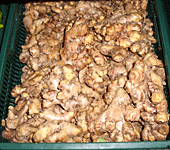
| Fresh ginger roots in a market. |
Ginger can be grown as a home garden plant or as a potherb,s so that its fresh roots and leaves can be readily picked up for immediate use. In the store, however, choose organic, fresh root over the dried form since it is superior in quality and flavor.
Fresh roots should feature heaviness in hand; stout, juicy, have a grey-yellow peel, and be free from dark spots or mold. Dried, powdered, or ground root can also be found in these stores; however, they may contain significantly decreased levels of volatile oils like gingerols.
Fresh root can be kept in the refrigerator for up to a month or so. Powdered/ground ginger should be stored in the fridge in airtight containers.
Culinary use
Wash fresh ginger root in cold running water or rinse for a few minutes to remove any sand, soil, or pesticide residues. The fresh root has a pungent flavor and spicy, peppery taste that may hit the senses in the palate and nostrils. In order to keep its fragrance and flavors intact, it is generally added at the last moment in the cooking recipes since prolonged cooking results in the evaporation of essential oils.
Fresh or dried ginger root along with garlic, cilantro, onion, tomato, cumin and mustard seeds made to a flavorful curry paste which then added to a variety of vegetable, meat, and curry/soup preparations.
The herb root is also used in the preparation of mango, lemon, and spondias (ambara in India) pickles.
Fresh root ginger can be used in the preparation of a variety of spicy snacks, candies, and gingerbread in the food industry.
Ginger tea is a popular drink in many Asian countries.
Safety profile
Ginger stimulates many secretory glands in the body. It has a "sialogogic" effect (increases salivary juice secretion in the mouth) on salivary glands; and increases bile secretion and its release. Therefore, the root may be contraindicated in patients with a history of gallstones.
Ginger root is also known to potentiate the toxicity of the anticoagulant drug warfarin, resulting in severe bleeding episodes. (Medical disclaimer).
You may also like to read:
≻≻-Greater galangal root nutrition facts and health benefits.
≻≻-Back to Herbs from Ginger root. Visit here for an impressive list of all varieties of herbs with complete illustrations of their nutrition facts and health benefits.
≻≻-Back to Home page.
Further Resources:
USDA National Nutrient Database. (Links open in new window)
Stanford School of Medicine Cancer information Page- Nutrition to Reduce Cancer Risk.