Bitter gourd (melon) nutrition facts
Bitter gourd (balsam pear/ bitter melon) is a young, tender, edible fruit pod in the Momordica genus of climbing vines. Although its bitter taste might turn some people away, nonetheless, it truly can sweeten your health through virtue of its disease-preventing and health-promoting phytochemical compounds.
Botanically, balsam pears belong to the Cucurbitaceae family, in the genus; Momordica, and are members of the same family as squash, watermelon, cantaloupes, cucumber, etc, belongs to.
Scientific name: Momordica charantia. Some of the related varieties are balsam pear, cundeamor, la-kwa, etc.
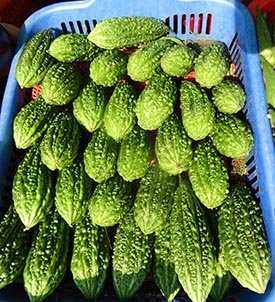 |
| Fresh bitter gourds in a market. |
Bitter melon is one of the traditional edible pod vegetables in many Asian countries. It is grown widely as a field crop as well as backyard vegetable and, in fact, is among the most bitter-tasting of all culinary vegetables.
Bitter melon is a temperate/tropical plant that probably originated in South-East Asia. Like in other members of the Cucurbitaceae family, it too is a fast-growing, trailing, or climbing vine with thin stems and tendrils which require a trellis to support their climbing vines.
 |
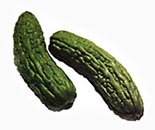 |
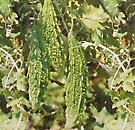
| Bitter gourds hanging down on a vine. This variety commonly found in Indian subcontinent. Note for pointed ends. | Bitter melons-oriental. Note for round, blunt ends. |
Bitter gourd pods are characterized by soft lengthwise ridges and uneven pebbly surfaces. Depending upon the cultivar type, its immature pods can be light to dark green and have oblong or oval shapes with a pointed tip at the blossom end. Internally, the flesh is white with rough-edged seeds, somewhat similar to ridge gourd seeds in appearance. As the fruits begin to mature, they gradually become hard, and turn yellow or brown in color.
Bitter gourd has a distinctly bitter and slightly astringent taste.
Momordica dioica, commonly known as the spiny gourd (ककोड़ा/कंटोला), is a closely related species in the bitter gourd family. It is used as a substitute vegetable for bitter gourd in Northern regions of India and some parts of South Asia. It is popular among those who wish for bitter melon's flavor but are averse to its bitter taste.
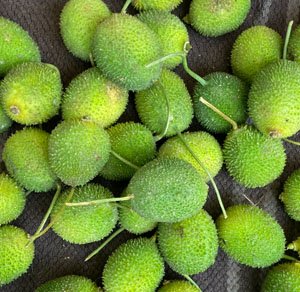 |
| Fresh Spiny gourds in a market. |
Health benefits of Bitter gourd
Bitter melon is very low in calories, carrying just 17 calories per 100 g. Nevertheless, its pods are rich sources of phytonutrients like dietary fiber, minerals, vitamins, and antioxidants.
Bitter melon notably contains phytonutrient, polypeptide-P, a plant insulin known to lower blood sugar levels. Also, it composes the hypoglycemic agent called Charantin. Charantin increases glucose uptake and glycogen synthesis inside the cells of the liver, muscle, and fatty (adipose) tissue. Together, these compounds may have been thought to be responsible for an overall reduction in blood sugar in type-2 diabetes.
Fresh pods are an excellent source of folates, carrying about 72 µg/100g (18% of RDA). Folic acid when taken by mothers during their early pregnancy time, would help reduce the incidence of neural tube defects in newborn babies.
Fresh bitter melon is an excellent source of vitamin C (100 grams of fresh pod provides 84 mg or about 140% of RDI).
Vitamin C is one of the powerful natural antioxidants that help scavenge harmful free radicals from the human body.
Further, it is an excellent source of health-benefiting flavonoids such as β-carotene, α-carotene, lutein, and zeaxanthin. It also contains a good amount of vitamin A. Together, these compounds help act as protective scavengers against oxygen-derived free radicals and reactive oxygen species (ROS) that play a role in aging, cancers, and various disease processes.
Bitter melon stimulates smooth digestion and peristalsis of food through the bowel until it is excreted from the body. Thus, it helps in relieving indigestion and constipation problems.
Further, it contains small amounts of B-complex vitamins such as niacin (vitamin B-3), pantothenic acid (vitamin B-5), pyridoxine (vitamin B-6), and minerals such as iron, zinc, potassium, manganese, and magnesium.
Early laboratory tests suggest that certain phytochemical compounds in bitter melon might be effective in the treatment of HIV infection.
| Principle | Nutrient Value | Percent of RDA |
|---|---|---|
| Energy | 17 Kcal | <1% |
| Carbohydrates | 3.70 g | 3% |
| Protein | 1.00 g | 2% |
| Total Fat | 0.17 g | 0.5% |
| Cholesterol | 0 mg | 0% |
| Dietary Fiber | 2.80 g | 7% |
| Vitamins | ||
| Folates | 72 µg | 18% |
| Niacin | 0.400 mg | 2.5% |
| Pantothenic acid | 0.212 mg | 4% |
| Pyridoxine | 0.043 mg | 3% |
| Riboflavin | 0.040 mg | 3% |
| Thiamin | 0.040 mg | 3.5% |
| Vitamin A | 471 IU | 16% |
| Vitamin C | 84 mg | 140% |
| Electrolytes | ||
| Sodium | 5 mg | <1% |
| Potassium | 296 mg | 6% |
| Minerals | ||
| Calcium | 19 mg | 2% |
| Copper | 0.034 mg | 4% |
| Iron | 0.43 mg | 5% |
| Magnesium | 17 mg | 4% |
| Manganese | 0.089 mg | 4% |
| Zinc | 0.80 mg | 7% |
| Phyto-nutrients | ||
| Carotene-ß | 190 µg | -- |
| Carotene-aplha | 185 µg | |
| Lutein-zeaxanthin | 170 µg | -- |
Selection and storage
Fresh bitter melon pods can be available in the markets around the seasons. While you buy them, look for fresh, bright pods that feature dark green without any blemishes or cuts on their surfaces. Choose young tender immature fruit pods. Immature pods are the least bitter since their astringent level increases as the pods mature.
At home, fresh bitter gourd can be placed in a plastic zip pouch and stored in the vegetable compartment of the refrigerator, where they stay fresh for up to a week.
Preparation and serving methods
Wash bitter gourds thoroughly in cold running water before cooking. Fresh pods, as well as young leaves, can be used for cooking. Marinating in the salt-spice mix and drying under the sun would help reduce this bitterness. There are several local traditional methods to reduce bitter taste, such as boiling in salted water for 5-10 minutes and then discarding the water, or marinating in yogurt for about 30 minutes.
Although its pith and seeds are discarded due to their higher alkaloid content, they can also be enjoyed in some Asian regions without any reservations.
Here are some serving tips:
 |
| Goya chanpuru. A okinawan dish prepared with bitter melon, tofu, egg and onion. Photo Courtesy: jetalone |
In India, where it popularly known as karela, it is used in a variety of recipes either stir-fried or stuffed with garam-masala, tomato, onions, green chilies, garlic and curry leaves.
Goya chanpuru, Okinawan stir-fry with bitter melon, onion, tofu, pork, and eggs, is a special dish of the health-conscious island inhabitants.
Known as ampalaya in the Philippines, it has been widely used in unique dishes like Pinakbet Ilocano, prepared with shrimp paste and mixed with vegetables like eggplant (aubergine) and okra.
Dried and powdered whole bitter gourd has been used in the preparation of iced or milk tea in some East Asian regions.
Bitter gourd is also used in the pickling preparations.
Safety profile
Bitter gourd may contain alkaloid substances like quinine and morodicine, resins, and saponin glycosides, which may be the cause of intolerance in some people. Their bitterness and toxicity may be reduced somewhat by parboiling or soaking in salted water for up to 10 minutes. Toxicity symptoms may include excessive salivation, facial redness, dimness of vision, stomach pain, nausea, vomiting, diarrhea, and muscular weakness. (Medical disclaimer).
≻≻-Back to Vegetables from Bitter Gourd. Visit here for an impressive list of vegetables with complete illustrations of their nutrition facts and health benefits.
≻≻-Back to Home page.
Further resources:
The triterpenoids of the bitter gourd (Momordica Charantia) and their pharmacological activities: A review-PubAg-USDA.
Stanford School of Medicine Cancer information Page- Nutrition to Reduce Cancer Risk.