Radish Nutrition facts
Radish is one of the nutritious root vegetables featured in both raw salads as well as in the main recipes. This widely used root vegetable belongs to the family of Brassica. In Chinese culture, radish along with cabbage and soybean curd (tofu) believed as healthy and sustenance food items. A popular Chinese proverb goes like this, "eating pungent radish and drinking hot tea, let the starved doctors beg on their knees."
The vegetable is thought to have originated in mainland China centuries ago, and today, it is one of the most widely cultivated crops throughout the world. Botanical name: Raphanus sativus.
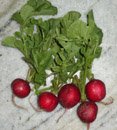 |
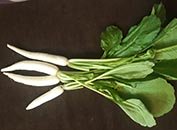 |
| Red globe radishes (Raphanus sativus). |
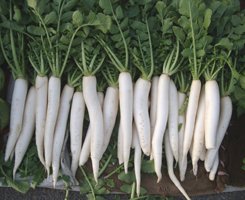
White icecle radish |
Radishes can come in different forms; widely varying in size, color, and crop duration. They are broadly categorized into four main types depending on the harvest season; summer, fall, winter, and spring. Growers classify them by their shapes, colors, and sizes, such as black or white with round or elongated roots.
The sharp, pungent flavor of radishes comes from the "isothiocyanate" compound in them, varying from mild in the case of white-icicles to very hot in the red globe and other pigmented varieties. Tender top greens of radish are also eaten as leafy greens in some parts of the world.
Daikon or Japanese radish is native to Asia. It is grown during the winter months and features elongated smooth, icy-white roots.
|
 |
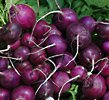 |
| Black spanish radish. | Green Chinese (lobok) radish. | Purple varieties. Photo courtesy: kthread |
Black Spanish radishes are peppery and more flavorful than their white counterparts.
Green radish is native to Northern China region. Its outer peel near the top stem end features a leafy-green color which, gradually changes to a white color near the lower tip. Inside, its flesh has a beautiful jade-green color and a sweet and less pungent flavor.
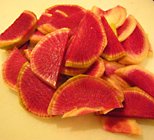
Watermelon radishes have watermelon like flesh inside. They are less peppery but mildly sweet something similar to that of white icicle varieties.
When left to grow for longer than the usual root-harvest period, all kinds of radishes bear small flowers, which subsequently develop into edible fruit pods. Rat-tailed radish is a type of seed-pod variety grown exclusively for its long rat-tail-like tapering edible pods. The pods feature a mixture of mild radish flavor and spiciness. Immature pods have the best flavor.
7 Amazing Health Benefits of Radish
Since ancient times, Chinese believe that eating radish and other brassica group vegetables such as cabbage, cauliflower, and napa cabbage would bring wholesome health.
They are one of the very low-calorie root vegetables. Fresh root provides just 16 calories per 100 grams. Nonetheless; they are an excellent source of antioxidants, electrolytes, minerals, vitamins, and dietary fiber.
Radish, like other cruciferous and Brassica family vegetables, contains isothiocyanate antioxidant compound called sulforaphane.
Studies suggest that sulforaphane has a proven role against prostate, breast, colon, and ovarian cancers by its cancer-cell growth inhibition, and cytotoxic effects on cancer cells.
Fresh roots are a good source of vitamin C; provide about 15 mg or 25% of DRI of vitamin C per 100 g. Vitamin C is a powerful water-soluble antioxidant required by the body for the synthesis of collagen. It helps the human body scavenge harmful free radicals, prevent cancers, and inflammation, and help boost immunity.
Also, they contain adequate levels of folates, vitamin B-6, riboflavin, thiamin, and minerals such as iron, magnesium, copper, and calcium.
Further, they contain many phytochemicals like indoles which are detoxifying agents and zeaxanthin, lutein, and beta-carotene, which are flavonoid antioxidants. Their total antioxidant strength, measured regarding oxygen radical absorbance capacity (ORAC value), is 1736 µmol TE/100 g.
| Principle | Nutrient Value | Percent of RDA |
|---|---|---|
| Energy | 16 Kcal | 1% |
| Carbohydrates | 3.40 g | 3% |
| Protein | 0.68 g | 1% |
| Total Fat | 0.10 g | <1% |
| Cholesterol | 0 mg | 0% |
| Dietary Fiber | 1.6 g | 4% |
| Vitamins | ||
| Folates | 25 µg | 6% |
| Niacin | 0.254 mg | 1.5% |
| Pyridoxine | 0.071 mg | 5.5% |
| Riboflavin | 0.039 mg | 3% |
| Vitamin A | 7 IU | <1% |
| Vitamin C | 14.8 mg | 25% |
| Vitamin E | 0 mg | 9% |
| Vitamin K | 1.3 µg | 1% |
| Electrolytes | ||
| Sodium | 39 mg | 2.5% |
| Potassium | 233 mg | 5% |
| Minerals | ||
| Calcium | 25 mg | 2.5% |
| Copper | 0.050 mg | 5% |
| Iron | 0.34 mg | 4% |
| Magnesium | 10 mg | 2.5% |
| Manganese | 0.069 mg | 2.5% |
| Zinc | 0.28 mg | 2% |
| Phyto-nutrients | ||
| Carotene-ß | 4 µg | -- |
| Carotene-a | 0 µg | -- |
| Lutein-zeaxanthin | 10 µg | -- |
Selection and storage
 |
 |
| Fresh radishes in a market. | Korean- radish. Note its large size. |
In general, radishes can be available year-round; with the peak season being winter and spring. Daikons are most flavorful and juicy during winter.
Look for the roots that feature fresh, stout, and firm in texture. Their top greens also should be fresh and feature crispy green without any yellow, shriveled leaves. Avoid roots that have cracks or cuts on their surface. Look carefully for the change in their texture and color. Yellowness indicated the stock is old. If the root yields to pressure and is soft, the interior likely be pithy instead of crispy.
Once at home, remove their top greens since they rob nutrients off the roots if left intact. Then wash thoroughly with clean water to rid of surface dust and soil. Store them in a zip pouch or plastic bag in the refrigerator where they remain fresh for up to a week.
Preparation and serving methods
Both root and top greens are employed in cooking. Just give a scrub-wash in clean water. Since antioxidant allyl-isothiocyanates that give a peppery, pungent flavor to radish are thickly concentrated in the skin, its peeling may be avoided. Trim the tip ends, and if you have to peel, then gently pare away the superficial layer only.
Here are some serving suggestions:
|
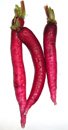 |
| Watermelon radish slices. Photo courtesy: Neeta | Elongated red skin radishes. |
Radishes can be eaten raw either as a whole or as a slaw or in salads with carrots, beets, cucumber, lettuce, etc.
In French breakfast, radishes are served with sweet butter and salt.
The roots are mixed with other vegetables in the preparation of steamed, stir-fried, or sauteed recipes in many regions.
In North India and Pakistan, the root is grated and mixed with spice and seasonings and stuffed inside bread to prepare "mooli parantha."
Pickled daikon (kimchi) is a traditional Korean specialty.
Radish pods (moongre in India) are eaten raw in salads or stir-fries in many parts of Asia.
Its top greens often mixed with other greens like spinach, turnip greens, etc., used in the preparation of soups, curries as well as in cooked vegetable recipes.
Safety profile
Radishes may contain goitrogens, plant-based compounds found in Cruciferous and Brassica family vegetables like cauliflower, broccoli, etc. Goitrogens may cause swelling of the thyroid gland and should be avoided in individuals with thyroid dysfunction. However, they may be used liberally in healthy persons. (Medical disclaimer).
≺≺ You may also like to read- Black radish nutrition facts and health benefits.
≺≺ Back to Vegetables from Radish. Visit here for an impressive list of vegetables with complete illustrations of their nutrition facts and health benefits.
≺≺ Back to Home page.
Further reading:
USDA National Nutrient Database.(opens new window)
Stanford School of Medicine Cancer information Page- Nutrition to Reduce Cancer Risk (Link opens in new window).
Antioxidant Functions of Sulforaphane: a Potent Inducer of Phase II Detoxication Enzymes J. W. FAHEY and P. TALALAY.