Purslane Nutrition Facts
Soft and succulent, purslane leaves contain more omega-3 fatty acids than certain fish oils. For vegetarians committed to avoiding all animal products, this healthy dark-green leafy vegetable provides a satisfying alternative, making you forget about fish in no time!
Botanically, this herbaceous leafy vegetable belongs to the family Portulacaceae and is scientifically known as Portulaca oleracea.
Other common names for this green leafy vegetable are pursley, pigweed, or verdolaga.
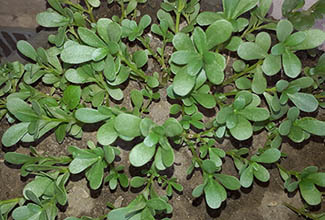 |
| Purslane (Portulaca oleracea). |
Purslane is native to the Indian subcontinent and is now widely distributed across continents, primarily as a wild weed. There are various varieties of pursley with differences in leaf size, thickness, arrangement, and pigment distribution. This hardy herb requires relatively less water and soil nutrients and thrives in sunny climates, growing up to 12-15 cm in height as a low-lying spread.
Its leaves possess a dense, mucilaginous texture with a subtly tangy and saline flavor. Both the leaves and delicate stems are suitable for consumption, while its golden flower buds find favor, particularly in salad preparations.
Purslane seeds, resembling grains of finely ground black tea, are commonly utilized in the production of herbal beverages.
Health Benefits of Purslane
This wonderful green leafy vegetable is very low in calories (just 16 kcal/100g) and fats; nonetheless, it is rich in dietary fiber, vitamins, and minerals.
Fresh leaves contain surprisingly more omega-3 fatty acids (α-linolenic acid) than any other leafy vegetable plant. 100 grams of fresh purslane leaves provide about 350 mg of α-linolenic acid.
Research studies show that consumption of foods rich in omega-3 fatty acids may reduce the risk of coronary heart disease, stroke, and help prevent the development of ADHD, autism, and other developmental differences in children.
It is an excellent source of Vitamin-A (1320 IU/100 g, providing 44% of RDA), one of the highest among green leafy vegetables. Vitamin-A is a known powerful natural antioxidant and an essential vitamin for vision. It is also required to maintain healthy mucosa and skin.
Consumption of natural vegetables and fruits rich in vitamin-A is known to help protect from lung and oral cavity cancers.
Purslane is also a rich source of vitamin-C and some B-complex vitamins like riboflavin, niacin, pyridoxine, and carotenoids, as well as dietary minerals such as iron, magnesium, calcium, potassium, and manganese.
Furthermore, present in purslane are two types of betalain alkaloid pigments: the reddish β-cyanins and the yellow β-xanthins. Both pigment types are potent antioxidants and have been found to have antimutagenic properties in laboratory studies [Proc. West. Pharmacol. Soc. 45: 101-103 (2002)].
| Principle | Nutrient Value | Percent of RDA |
|---|---|---|
| Energy | 16 Kcal | 1.5% |
| Carbohydrates | 3.4 g | 3% |
| Protein | 1.30 g | 2% |
| Total Fat | 0.1 g | 0.5% |
| Cholesterol | 0 mg | 0% |
| Vitamins | ||
| Folates | 12 µg | 3% |
| Niacin | 0.480 mg | 3% |
| Pantothenic acid | 0.036 mg | 1% |
| Pyridoxine | 0.073 mg | 5.5% |
| Riboflavin | 0.112 mg | 8.5% |
| Thiamin | 0.047 mg | 4% |
| Vitamin A | 1320 IU | 44% |
| Vitamin C | 21 mg | 35% |
| Electrolytes | ||
| Sodium | 45 mg | 3% |
| Potassium | 494 mg | 10.5% |
| Minerals | ||
| Calcium | 65 mg | 6.5% |
| Copper | 0.113 mg | 12.5% |
| Iron | 1.99 mg | 25% |
| Magnesium | 68 mg | 17% |
| Manganese | 0.303 mg | 13% |
| Phosphorus | 44 mg | 6% |
| Selenium | 0.9 µg | 2% |
| Zinc | 0.17 mg | 1.5% |
Selection and storage
|
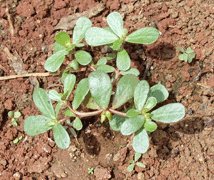
| Purslane plant in a backyard garden. |
In the market, purchase fresh and healthy-looking purslane; carefully inspect for mold, yellow, or dark spots as they indicate inferior quality. Opt for organic produce whenever feasible.
Rinse fresh leaves and stems in clean, cold running water to remove any sand and residues of insecticides/fungicides. After cleaning, pat dry with a soft absorbant cloth to remove excess moisture before storing it in the refrigerator.
Purslane can be stored in the fridge for about 3-4 days but should be consumed while the leaves are still fresh and not wilted.
Preparation and serving methods
The stems and flower buds are also edible. Trim the tough stems near the roots using a sharp knife. Cook at low temperatures for a shorter period to preserve the majority of nutrients. Although antioxidant properties are significantly reduced through frying and boiling, its minerals, carotenes, and flavonoids may remain intact with steam cooking.
Here are some serving tips:
Fresh, raw leaves can be used in salads or as vegetable juice.
Fresh, tender leaves are suitable for salads. Sautéed and gently stewed stems and leaves can be served as a side dish with fish and poultry.
It has also been used in soup and curry (Goni soppu curry) preparations and eaten with rice and ragi cake (ragi mudde/finger-millet cake) in many mouthwatering purslane recipes in the South Indian region, especially in parts of the former Mysore province of Karnataka state.
Stir-fried and mixed with other like-minded greens such as spinach and vegetables, it creates favorite dishes.
Safety Profile
Purslane contains oxalic acid, a naturally occurring substance found in some vegetables, which may crystallize as oxalate stones in the urinary tract in some people. Fresh leaves contain 1.31 g of oxalic acid per 100 g, more than what is found in spinach (0.97 g/100 g) and cassava (1.26 g/100 g). Therefore, individuals with known oxalate urinary tract stones are advised to avoid consuming purslane and certain vegetables from the Amaranthaceae and Brassica families. Maintaining adequate water intake is encouraged to support normal urine output. (Medical disclaimer).
≺≺Back to Vegetables from Purslane. Visit here for an impressive list of vegetables with complete illustrations of their nutrition facts and health benefits.
≺≺Back to Home page.
Further resources:
Purslane - Weed it or eat it!- University of Illinois extension.
Stanford School of Medicine Cancer information Page- Nutrition to Reduce Cancer Risk.
Proc. West. Pharmacol. Soc. 45: 101-103 (2002).
Simopoulos AP, Salem N Jr. Purslane: a terrestrial source of omega-3 fatty acids. N Engl J Med 1986;315:833.