Parsley Nutrition facts
Parsley, a widely recognized culinary and medicinal herb, is esteemed for its unique antioxidants and disease-preventing properties, making it a popular functional food. Native to the Mediterranean region, this small leafy herb belongs to the Apiaceae family, specifically the genus Petroselinum, with its botanical name being Petroselinum crispum.
Characterized by dark-green leaves reminiscent of coriander leaves, especially in the case of flat-leaf parsley, this herb distinguishes itself with larger leaves and a milder flavor compared to leaf-coriander. It finds extensive use in Mediterranean, East European, and American cuisines.
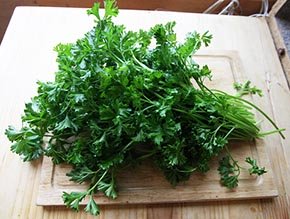 |
| Parsley-flat leaf variety. Note smooth, broad, coriander like leaves. Photo: Wheeler |
Several cultivars of parsley thrive throughout Europe. Italian, also known as flat-leaf parsley (Petroselinum crispum neapolitanum), is particularly renowned in Mediterranean regions, boasting a more robust flavor compared to curly-leaf parsley.
In Japan and China, Mitsuba (Cryptotaenia japonica) serves as a garnish herb, offering an alternative to parsley. Mitsuba shares a similar flavor and appearance to European flat-leaf parsley.
Health Benefits of Parsley
Parsley stands out as one of the low-calorie herbs, with just 36 calories per 100 grams of fresh leaves. Moreover, its leaves are devoid of cholesterol and fat while being abundant in antioxidants, vitamins, minerals, and dietary fiber. Overall, the herb aids in controlling blood cholesterol levels and may provide protection against free radical-mediated injury and cancers.
Parsley contains several health-benefiting essential volatile oils such as myristicin, limonene, eugenol, and a-thujene.
The essential oil Eugenol, found in this herb, has been used therapeutically in dentistry as a local anesthetic and antiseptic agent for teeth and gum diseases. Eugenol has also demonstrated the ability to reduce blood sugar levels in diabetics. However, further detailed research studies are required to substantiate this role.
Parsley is rich in polyphenolic flavonoid antioxidants, including apiin, apigenin, crisoeriol, and luteolin, and has been recognized as one of the plant sources with high-quality antioxidant activities.
The total ORAC value, measuring the antioxidant strength of 100 grams of fresh, raw parsley, is 1301 µmol TE (Trolox equivalents).
The herb serves as a good source of minerals like potassium, calcium, manganese, iron, and magnesium. A 100-gram serving of fresh herb provides 554 milligrams or 12% of the daily required levels of potassium. Potassium, a crucial component of cell and body fluids, helps regulate heart rate and blood pressure by counteracting the effects of sodium. Iron is essential for the production of heme, a critical oxygen-carrying component inside red blood cells. The human body utilizes manganese as a co-factor for the antioxidant enzyme superoxide dismutase.
Additionally, the herb is abundant in many antioxidant vitamins, including vitamin A, ß-carotene, vitamin C, vitamin E, zeaxanthin, lutein, and cryptoxanthin. It also serves as an excellent source of vitamin K and folates. Zeaxanthin aids in preventing age-related macular degeneration (ARMD) in the elderly population by virtue of its antioxidant and ultraviolet light-filtering functions.
Fresh herb leaves are rich in essential vitamins such as pantothenic acid (vitamin B-5), riboflavin (vitamin B-2), niacin (vitamin B-3), pyridoxine (vitamin B-6), and thiamin (vitamin B-1). These vitamins play a crucial role in carbohydrate, fat, and protein metabolism by acting as co-enzymes in the human body.
Parsley is perhaps the richest herbal source of vitamin K, providing 1,640 micrograms or 1366% of the recommended daily intake. Vitamin K has been found to potentially promote bone health by stimulating osteoblastic activity in the bones. It also plays an established role in treating Alzheimer's disease patients by limiting neuronal damage in their brains.
Wonderful! Humble parsley may have just 36 calories per 100 grams, but its phytonutrient profile rivals that of any high-calorie food source. 3.5 Oz (100 g) of this fresh herb provides:
- 38% of folates,
- 220% of vitamin C,
- 281% of vitamin A,
- 1366% of vitamin K,
- 14% of calcium,
- 77.5% of iron, and
- 5561 micrograms of zeaxanthin.
- 5054 micrograms of beta-carotene.
(Note: the values are in % of RDA per 100 g (RDA-Recommended daily allowance))
| Principle | Nutrient Value | Percent of RDA |
|---|---|---|
| Energy | 36 Kcal | 1.5% |
| Carbohydrates | 6.33 g | 5% |
| Protein | 2.97 g | 5% |
| Total Fat | 0.8 g | 3% |
| Cholesterol | 0 mg | 0% |
| Dietary Fiber | 3.3 g | 8.5% |
| Vitamins | ||
| Folates | 152 µg | 38% |
| Niacin | 1.313 mg | 8% |
| Pantothenic acid | 0.400 mg | 8% |
| Pyridoxine | 0.090 mg | 7% |
| Riboflavin | 0.098 mg | 7.5% |
| Thiamin | 0.086 mg | 7% |
| Vitamin A | 8424 IU | 281% |
| Vitamin C | 133 mg | 220% |
| Vitamin E | 0.75 mg | 5% |
| Vitamin K | 1640 µg | 1366% |
| Electrolytes | ||
| Sodium | 56 mg | 4% |
| Potassium | 554 mg | 12% |
| Minerals | ||
| Calcium | 138 mg | 14% |
| Copper | 0.149 mg | 16.5% |
| Iron | 6.20 mg | 77.5% |
| Magnesium | 50 mg | 12.5% |
| Manganese | 0.160 mg | 7% |
| Phosphorus | 58 mg | 8% |
| Zinc | 1.07 mg | 10% |
| Phyto-nutrients | ||
| Carotene-ß | 5054 µg | -- |
| Crypto-xanthin-ß | 0 µg | -- |
| Lutein-zeaxanthin | 5561 µg | -- |
Selection and Storage
Fresh and dried parsley are both available in markets year-round. It's advisable to opt for fresh leaves over the dried variety as they offer superior flavor and are rich in essential vitamins and antioxidants. Look for vibrant green leaves and firm stalks, avoiding any signs of mold, dark spots, or yellowing.
Similarly to other dried herbs, when purchasing dried parsley, prioritize organic options to ensure it hasn't been irradiated and is free from pesticide residues.
To store fresh parsley, keep it in the refrigerator either packed in a zip pouch or wrapped in a slightly damp paper towel. Dried parsley can be stored for several months in a tightly sealed glass container placed in a cold, dark, and dry environment.
Medicinal Uses
The leaves, stalks, and roots of parsley herb plant possess antiseptic and carminative properties.
Eugenol has also been found to reduce blood sugar levels in diabetics; however, further detailed studies are required to establish its role.
An extraction from the herb has been found to have diuretic effects.
Preparation and Serving methods
Parsley should be thoroughly washed in water to remove sand, dirt, and any residual pesticides. Trim the roots, thick parts of stems, and any bruised or old leaves. Generally, parsley is added at the end of recipes to preserve its fragrance and aromatic flavor.
Here are some serving tips:
|
|
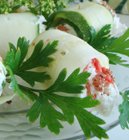
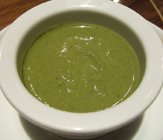
| Delicious zucchini bite with parsley as a garnish. Photo: norwichnuts | Mediterranean green sauce-Salsa verde. Photo: toyohara |
The herb is widely used as a garnish, with many dishes served with freshly chopped green parsley sprinkled on top.
It has been utilized in the preparation of numerous popular dishes in Mediterranean and European cuisine since ancient times. Alongside other herbs and spices, it serves as a flavoring agent in vegetable, chicken, fish, and meat dishes.
It is a common ingredient in the renowned Mediterranean green sauce, "salsa verde," a cold sauce comprising parsley, capers, garlic, onion, anchovies, olive oil, and vinegar.
Freshly chopped parsley makes a fantastic addition to a green salad.
Both fresh and dried parsley leaves can be used in the preparation of chutneys, dips, pesto, etc.
Safety Profile
Pregnant women should avoid consuming parsley in large amounts or as a drug or supplement. The essential oil found in its root, leaf, or seed could potentially induce uterine stimulation, leading to bleeding and preterm labor.
This herbaceous plant is notably high in oxalic acid, with 1.70 mg per 100 g. Prolonged consumption of oxalate-rich foods may result in gouty arthritis, kidney stones, and mineral nutrient deficiencies.
Parsley oil contains furanocoumarins and psoralens, which may cause extreme photosensitivity if ingested orally. (Medical disclaimer).
≻≻-Back to Herbs from Parsley. Visit here for an impressive list of all varieties of herbs with complete illustrations of their nutrition facts and health benefits.
≻≻-Back to Home page.
Further Resources:
Refer Stanford School of Medicine Cancer information Page-Nutrition to Reduce Cancer Risk (Opens in New Window).
Pub med: Parsley (Opens new window).