Loquat fruit nutrition facts
Succulent, tangy yet sweet, wonderfully delicious loquat fruit is rich in vitamins, minerals, and antioxidants. This unique fruit originated in the wild, evergreen rainforests of Southeastern China, from where it spread all across the world including Japan. Some of the common names of loquat include Japanese plum, Japanese medlar, Maltese plum, etc.
Loquat plant can be described as an evergreen, large shrub or small tree belonging to the family of Rosaceae, in the genus; Eriobotrya.
The botanical name is Eriobotrya japonica and closely related to the "apples."
 |
|
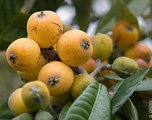
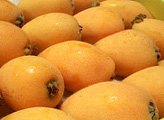
| Loquats bunch. Courtesy: DeusXFlorida | Golden yellow loquats. Courtesy: Kanko |
Loquat fruits begin appearing on the trees by the end of the winter season. Mature fruits can be ready to harvest by June in Japan. However, their harvesting season may vary from region to region. They are oval to pear in shape, appear in bunches of 5-20, and measure about 3 cm in width and 3-5 cm in length.
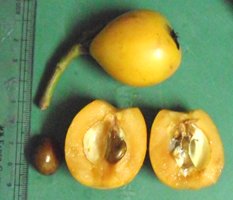
In general, the fruits are allowed to ripen on the tree itself before harvesting. Ripe fruits have a soft texture. Externally, its yellow-orange skin is fuzzy but smooth. Internally, the flesh is either white or golden-yellow depending on the cultivar type. The fruit encloses 3-5 large, brown seeds. Seeds are inedible and may carry toxic cyanogen-glycosides.
Being a member of Rosaceae family of fruits, loquats have a similar taste and flavor as that of apples; tart and sweet with a pleasant aroma. However, they are soft and juicy in texture instead of crispy as in apples. Loquat's leaves are also employed in traditional medicines and as herbal tea in many parts of the world.
Health Benefits of Loquat fruit
Loquats are low-calorie fruits; provide just 47 calories per 100 g. Nonetheless, they are rich in insoluble dietary fiber, pectin. Pectin holds back moisture inside the colon and thus functions as a bulk laxative. This way, it helps protect the colon mucosa by cutting exposure time to toxic substances as well as binding to cancer-causing chemicals in the colon.
Pectin has also been shown to reduce blood cholesterol levels by lowering its reabsorption in the colon through binding bile acids, resulting in its excretion from the body.
Loquat fruit is an excellent source of vitamin A (provides about 1528 IU or 51% of daily recommended levels of this vitamin per 100g), and phenolic flavonoid antioxidants such as chlorogenic acid, neo-chlorogenic acid, hydroxybenzoic acid, feruloyl quinic acid, protocatechuic acid, epicatechin, coumaric acids, and ferulic acid. Ripe loquats have more chlorogenic acid concentrations.
Vitamin A helps maintain the integrity of mucosa and skin. Lab studies suggest that the consumption of natural fruits rich in vitamin A and flavonoids may offer protection from lung and oral cavity cancers.
Fresh fruit is good in potassium and some B-complex vitamins such as folates, vitamin B-6, and niacin and contains small amounts of vitamin C. Potassium is an important component of cells and body fluids that helps to regulate heart rate and blood pressure.
Furthermore, it is also an excellent source of iron, copper, calcium, manganese, and other minerals. The human body uses manganese as a co-factor for the antioxidant enzyme superoxide dismutase. Copper is essential in the production of red blood cells. Iron is required as a cofactor in cellular oxidation as well as in red blood cell formation.
| Principle | Nutrient Value | Percent of RDA |
|---|---|---|
| Energy | 47 Kcal | 2.4% |
| Carbohydrates | 12.14 g | 9% |
| Protein | 0.43 g | 2% |
| Total Fat | 0.20 g | 1% |
| Cholesterol | 0 mg | 0% |
| Dietary Fiber | 1.70 g | 4% |
| Vitamins | ||
| Folates | 14 µg | 3.5% |
| Niacin | 0.180 mg | 1% |
| Pyridoxine | 0.100 mg | 8% |
| Riboflavin | 0.024 mg | 2% |
| Thiamin | 0.019 mg | 2% |
| Vitamin A | 1528 IU | 51% |
| Vitamin C | 1 mg | 2% |
| Electrolytes | ||
| Sodium | 1 mg | 0% |
| Potassium | 266 mg | 6% |
| Minerals | ||
| Calcium | 16 mg | 1.6% |
| Copper | 0.040 mg | 4.5% |
| Iron | 0.28 mg | 3.5% |
| Magnesium | 13 mg | 3% |
| Manganese | 0.148 mg | 6.5% |
| Phosphorus | 27 mg | 4% |
| Selenium | 0.6 µg | 1% |
| Zinc | 0.05 mg | 0.5% |
Selection and storage
|
| Loquat fruit internal structure with seeds. |
Loquat fruit season begins in June in Japan. Generally, the fruits can be ready for harvesting once their skin turns yellow and the flesh becomes soft. Ripe fruits should be carefully picked up from the bunch and handled to avoid damage.
In the store, buy fresh ripe fruits featuring a bright-yellow, smooth surface and impart a mild yet sweet aroma. They should be devoid of any wrinkles, cuts, and patches on the skin. Avoid any overly softened fruits with spots as they tend to perish early.
Loquats keep well for up to two weeks in the fruit/vegetable compartment of the home refrigerator.
Preparation and serving methods
Wash loquats in cold water before consuming to remove any surface dirt or pesticide residues.
Its flesh just underneath the skin is rather sweeter than its central tart pulp. Skin can be peeled easily. Peeled fruits are eaten fresh or may be mixed with other fruits like banana, mango, and orange sections in salads.
Here are some serving tips:
Loquat Fruit sections are a great addition to fruit salads.
They are also used in desserts or as a pie filling, or chopped and cooked to prepare a sauce.
Loquat fruit is also made into jam, jelly and poached in sugar syrup with cinnamon to make delicious loquat fruit syrup.
Safety profile
The loquat fruit seeds contain several toxic alkaloids like cyanogen-glycosides, which when consumed, can cause serious life-threatening symptoms like vomiting, breathlessness, and death. Children may be advised to avoid chewing seeds. Also, adults should supervise them while eating.
(Medical Disclaimer: The information and reference guides in this website are intended solely for the general information to the reader. It is not to be used to diagnose health problems or for treatment purposes. It is not a substitute for medical care provided by a licensed and qualified health professional. Please consult your health care provider for any advice on medications).
≻≻-Back to Fruits from Loquat fruit. Visit here for an impressive list of all varieties of fruits with complete illustrations of their nutrition facts and health benefits.
≻≻-Back to Home page.
Further Resources:
Stanford School of Medicine Cancer information Page- Nutrition to Reduce Cancer Risk.
Butterfield, Harry M. A History of Subtropical Fruits and Nuts in California. University of California, Agricultural experiment Station. 1963.