Coconut water Nutrition facts
Coconut water is the liquid (juicy secretion) collection in the endosperm (inside the cavity) of a young, tender coconut. Its water is one of nature’s most refreshing drinks enjoyed worldwide for its nutritious and health-benefiting properties.
The water of tender coconuts is a clear liquid, sweet, and sterile, and composed of unique chemicals such as sugars, vitamins, minerals, electrolytes, enzymes, amino acids, cytokine, and phytohormones. To collect its water, a tender, green, healthy coconut is cut near its crown. For the purpose of reaping their drink, normally, 5-7 months young and slightly immature coconuts are gathered from a coconut tree.

|
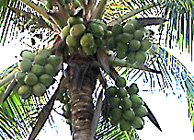
|
| Sweet, tender coconut water Photo courtesy by: bortescristian |
Tender coconuts in a coconut palm. |
Botanically, coconut plant belongs to the Arecaceae family of palm trees and has the scientific name: Cocos nucifera.
Each coconut may contain about 200 to 1000 ml of water depending upon cultivar type and size. Any nuts younger than five months of age tend to be bitter in taste and devoid of nutrients. In contrast, mature coconuts contain less water, and their endosperm thickens quickly into white edible meat (kernel). Coconut milk obtained from the meat, therefore, should not be confused with coconut water.
Coconut palm flourishes well under the coastal tropical environments. A coconut tree may yield several hundreds of tender nuts each season. Different species of coconut palms are grown all over the tropics. Naturally, their taste and flavor of water show variations according to saline content in the soil, distance from the seashore, and climate conditions.
Health benefits of coconut water
Coconut water is a very refreshing drink to beat the torching tropical summer thirst. Its liquid is packed with simple sugars, electrolytes, and minerals to replenish dehydration conditions inside the human body.
Research studies suggest that cytokinins (e.g., kinetin and trans-zeatin) in coconut water were found to have significant anti-aging, anti-carcinogenic, and anti-thrombotic (anti-clot formation) effects.
Coconut water is offered to patients with diarrhea in many tropic regions to replace the fluid loss from the gastrointestinal tract and to reduce the need for hospitalization. The osmolarity of tender coconut water is slightly greater than that of WHO recommended ORS (Oral Rehydration Therapy) solution. The presence of other biological constituents like amino acids, enzymes, minerals, and fatty acids may account for this higher osmolarity. Nonetheless, unlike WHO-ORS, its water is very low in sodium and chlorides, but rich in sugars and amino acids. This well-balanced fluid composition, along with much-needed calories, would be an ideal drink instead of any other kind of soft drink beverages available in the markets to correct dehydration conditions.
Coconut water is composed of many naturally occurring bioactive enzymes such as acid phosphatase, catalase, dehydrogenase, diastase, peroxidase, RNA-polymerases, etc. In effect, these enzymes help in digestion and metabolism.
Despite being very light, its water proportionately has a better composition of minerals like calcium, iron, manganese, magnesium, and zinc than some of the fruit juices like oranges. (Compare the mineral composition of oranges).
Its liquid is also an excellent source of B-complex vitamins such as riboflavin, niacin, thiamin, pyridoxine, and folates. These vitamins are essential in the sense that the human body requires them from external sources to replenish.
Coconut water carries a good amount of electrolyte potassium. 100 ml of water has 250 mg of potassium and 105 mg of sodium. Together, these electrolytes help replenish electrolyte deficiency in the body due to diarrhea (loose stools).
Further, fresh coconut water has a small amount of vitamin C (Ascorbic acid); It provides about 2.4 mg or 4% of RDA. Vitamin C is a water-soluble antioxidant.
| Principle | Nutrient Value | Percent of RDA |
|---|---|---|
| Energy | 19 Kcal | 1% |
| Carbohydrates | 3.71 g | 3% |
| Protein | 0.72 g | 1.5% |
| Total Fat | 0.20 g | 1% |
| Cholesterol | 0 mg | 0% |
| Dietary Fiber | 1.1 g | 3% |
| Vitamins | ||
| Folates | 3 µg | 0.75% |
| Niacin | 0.080 mg | 0.5% |
| Pantothenic acid | 0.043 mg | <1% |
| Pyridoxine | 0.032 mg | 2.5% |
| Riboflavin | 0.057 mg | 4% |
| Thiamin | 0.030 mg | 2.5% |
| Vitamin C | 2.4 mg | 4% |
| Vitamin A | 0 | 0% |
| Vitamin E | 0 mg | 0% |
| Vitamin K | 0 | 0% |
| Electrolytes | ||
| Sodium | 105 mg | 7% |
| Potassium | 250 mg | 5% |
| Minerals | ||
| Calcium | 24 mg | 2.4% |
| Copper | 40 mcg | 4.5% |
| Iron | 0.29 mg | 3.5% |
| Magnesium | 25 mg | 6% |
| Manganese | 0.142 mg | 6% |
| Zinc | 0.10 mg | 1% |
| Phyto-nutrients | ||
| Auxin (Gibberlin) | Present | -- |
| Carotene,ß | 0 µg | -- |
| Cytokines | Present | -- |
| Lutein-zeaxanthin | 0 µg | -- |
| Leucoanthocyanin | Present | -- |
Selection and storage
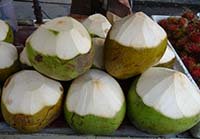 |
| Tender coconuts- ready to drink! |
Fresh tender coconuts can be readily available in the markets in tropical regions year-round. However, they require importation into the semitropical and cold regions. Nowadays, ready-to-use tender coconuts, imported from Thailand and Malaysia, can be easily available in the USA, European Union, and Canada.
In the supermarkets, coconut water is also sold in packs and bottles as well. However, its overall nutritional profile may not be the same and up to the mark in terms of vitamins and enzyme levels, since some additives and preservatives are added to enhance shelf life.
At home, fresh tender coconuts can be kept at room temperature for about 5-10 days. Once opened, its liquid soon turns sour and off-flavored due to intense enzymatic activity. Instead, store it in the refrigerator, if not used immediately.
Preparation and serving tips

|
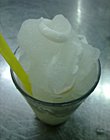 |
| Refreshing coconut drink. | Iced coconut juice with tender coconut meat topping. Photo courtesy: Andrew currie. |
To prepare, use a long sickle to cut open its thick, outer layer (exocarp), either at the top or bottom end, and break the hard inner shell to expose the endocarp (inner cavity) holding coconut water. You should be careful if you are doing it yourself. Some skills and expertise are needed to do this job and to avoid injuries.
To enjoy its refreshing water, use a straw. Otherwise, the whole fruit is turned upside down to transfer its water into a wide-mouthed bottle or bowl.
Enjoy the coconut drink without any additions.
Iced coconut water can be a refreshing drink.
Fresh water can be made special drink adding lemon slices, mint leaves, and orange zest.
Its gel-like meat (kernel) inside the young tender coconuts is very sweet and delicious.
Safety profile
Coconut water is a universally appealing drink. There are no known reactions of any sort notified so far after its consumption. It is not only cherished in healthy but also considered safe in pregnancy, infants as well as in illness conditions like diarrhea. (Medical disclaimer).
Note:
The discussion on this page is solely dedicated to water (liquid) or solution of tender coconuts, and not about Coconut milk, Coconut meat, Coconut oil or any products of the coconut tree.
Coconut water is a universally appealing, pleasant drink. It composes many naturally-occurring bioactive enzymes, simple sugars, electrolytes, and vitamins. It is not only cherished among healthy but also considered safe in pregnancy, infants as well as in some diseases.
Also read ≻≻-
≻≻-Coconut nutrition facts.
≻≻-Coconut milk nutrition facts.
≻≻-Coconut oil nutrition facts.
≻≻-Back to Home page from Coconut water.
Further Resources:
Coconut Research center- PDF.