Tarragon herb Nutrition facts
French Tarragon herb, also known as dragon wort, is a popular culinary herb employed as a flavoring agent, especially in Mediterranean cuisine. This aromatic, perennially growing plant is rich in phytonutrients as well antioxidants that help promote health and prevent diseases.
Botanically, tarragon belongs within the family of Asteraceae, in the genus: Artemisia, and known scientifically as Artemisia dracunculus. sativa. The plant is thought to have originated in the Central Asia region, probably in Siberia.
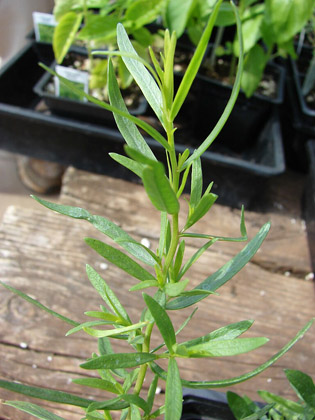 |
| Tarragon herb. Note lanceolated, dark-green leaves and thin woody stem. (Photo by-Forest and Kim Starr) |
This herb is a small shrub featuring slim woody branching stems that reach up to a meter in height. It grows well in fertile-rich, sandy soil with adequate sunlight. Its leaves feature a smooth, dark green surface with pointed ends.
Russian tarragon (A. dracunculoides) is a more robust, closely related species of French tarragon. It, however, is quite inferior in flavor to its Mediterranean counterpart and hence, less preferred in cooking.
Tarragon herb Health benefits
This exquisite herb is rich in numerous health-benefiting phytonutrients that are indispensable for optimum health.
The main essential oils in tarragon are estragole (methyl chavicol), cineol, ocimene and phellandrene.
Traditionally, tarragon has been employed as a traditional remedy to stimulate appetite and alleviate anorexic symptoms.
Scientific studies suggest that poly-phenolic compounds in this herb help lower blood sugar levels.
Fresh tarragon herb is one of the highest antioxidant value food sources among the common herbs. Its total measured ORAC (Oxygen radical absorbance capacity) value is 15,542 Trolex equivalents (TE) per 100 g.
Laboratory studies on tarragon extract show certain compounds in them inhibit platelet activation, preventing platelet aggregation and adhesion to the blood vessel wall. It, thus, helps prevent clot formation inside tiny blood vessels of the heart and brain protecting from heart attack, and stroke.
The herb is a very rich source of vitamins such as vitamin C, and vitamin A as well a B-complex group of vitamins such as folates, pyridoxine, niacin, riboflavin, etc., that function as antioxidants as well as co-factors for enzymes in the metabolism.
Tarragon is a notably excellent source of minerals like calcium, manganese, iron, magnesium, copper, potassium, and zinc. Manganese is utilized by the body as a co-factor for the antioxidant enzyme, superoxide dismutase. Iron is essential for cellular respiration (co-factors for cytochrome-oxidase enzyme) and blood cell production.
Medicinal uses of Tarragon
Tarragon herb has been used in various traditional medicines for stimulating the appetite and as a remedy for anorexia, dyspepsia, flatulence, and hiccups.
The essential oil, eugenol in the herb has been in therapeutic use in dentistry as a local anesthetic and antiseptic for toothache complaints.
Tarragon tea may help cure insomnia. (Medical disclaimer).
| Principle | Nutrient Value | Percent of RDA |
|---|---|---|
| Energy | 295 Kcal | 15% |
| Carbohydrates | 50.22 g | 38% |
| Protein | 22.77 g | 40% |
| Total Fat | 7.24 g | 24% |
| Cholesterol | 0 mg | 0% |
| Dietary Fiber | 7.4 g | 19% |
| Vitamins | ||
| Folates | 274 μg | 68.5% |
| Niacin | 8.950 mg | 56% |
| Pyridoxine | 2.410 mg | 185% |
| Riboflavin | 1.339 mg | 103% |
| Thiamin | 0.251 mg | 21% |
| Vitamin A | 4200 IU | 140% |
| Vitamin C | 50.0 mg | 83% |
| Electrolytes | ||
| Sodium | 62 mg | 4% |
| Potassium | 3020 mg | 64% |
| Minerals | ||
| Calcium | 1139 mg | 114% |
| Copper | 0.677 mg | 75% |
| Iron | 32.30 mg | 403% |
| Magnesium | 347 mg | 87% |
| Manganese | 7.967 mg | 346% |
| Zinc | 3.90 mg | 35% |
Selection and storage
French tarragon leaves can be available fresh during the late spring and summer season. Its terminal growing tips may be gathered for fresh use. Oftentimes, the herb is grown in the backyard so that its fresh leaves can easily be gathered for immediate use in cooking.
Tarragon leaves may be harvested at the flowering time for drying slowly, either under sunlight or gentle heat. Dried tarragon can be available in the herb stores year-round.
To choose, try to buy fresh leaves whenever possible for better flavor and nutritional benefits. Look for the herb that is rich in fragrance. Avoid those with shriveled, discolored old stocks.
Once at home, wash the leaves in clean running water, pat dry with absorbent paper, and store inside the vegetable compartment of the refrigerator for immediate use. Dried tarragon, however, should be stored inside an airtight container and stored in a cool dark place where it will stay for up to six months.
Preparation and serving methods
Fresh tarragon herb should be washed before use in cooking. In general, the herb is added in small amounts to recipes at the last moment in order to retain flavor and taste.
Culinary uses
Generally, the herb is added at the final moment to the recipes in small amounts in order to retain flavor and taste.
Here are some serving tips:
Fresh tarragon is used in green salads.
Fresh as well as dry leaves may be used as flavoring base (in marinate) to fish, lamb and poultry.
Tarragon herb is one of the main ingredients in French béarnaise sauce, a hot emulsified butter sauce made of clarified butter, egg yolks, shallot, chervil, peppercorn, and tarragon vinegar.
Furthermore, it is used as flavoring base in traditional Christmas breads called, potica.
Tarragon herb is also used to infuse vinegar and olive oil
Safety profile
Tarragon essential oil, estragole, may cause skin irritation in some individuals.
Furher, according to the "European commission scientific committee on food" estragole and its metabolite 1'-hydroxyestragole may induce hepatic tumor in laboratory animals. Therefore, it is recommended to use in to small quantities. (Medical disclaimer).
≺≺ Back to Herbs from Tarragon herb. Visit here for an impressive list of all varieties of herbs with complete illustrations of their nutrition facts and health benefits.
≺≺ Back to Home page.
Further Resources: