Swiss chard (silverbeet) Nutrition facts
Succulent Swiss chard, also known as spinach-chard or silverbeet, is one of the favorite green leafy vegetables of European origin. Botanically, it belongs to the beet family (Chenopodiaceae) of plants which also includes table beets, sugar beets, garden beets, etc. garden-beets, etc.
Scientific name: Beta vulgaris, Cicla group.
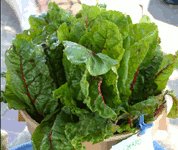 |
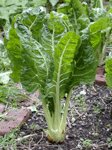 |
| Red-stalk chard. (Photo-by LaGrande farmer's market) | White-stalk chard. (Photo- by joephoto) |
Chard is seasonal leafy greens grown widely around the Mediterranean region. It is available at its best during the summer months from June until November.
Chard features distinctly large dark-green leaves with prominent petioles and well-developed edible stalk. In general, its leaves are harvested at various stages of maturity depending on their use in recipes. While the whole plant with its tender young leaves can be harvested for salad preparation, mature, over-size leaves with slightly tough textured stems may be picked up for sautéing and cooking in dishes.
Swiss chard comes in a variety of types based on their bright, crunchy stalks and petiole color:
Green stalk: Lucullus.
Red stalk: Charlotte, Rhubarb Chard.
Multi-color (variegated) stalk: Bright lights (white, orange, yellow, purple, pink).
Health benefits of Swiss chard
Swiss chard, just like spinach, is the storehouse for many phytonutrients that have health promotional and disease prevention properties.
Chard is very low in calories (19 kcal per 100 g fresh, raw leaves) and fats, recommended in cholesterol-controlling and weight reduction programs.
Chard leaves are an excellent source of antioxidant vitamin, vitamin-C. Its fresh leaves provide about 33% of the recommended levels per 100 g. As a powerful water-soluble antioxidant, vitamin C helps remove free radicals and reactive oxygen species (ROS) from the human body through its reduction potential properties. Research studies suggest that regular consumption of foods rich in vitamin C helps maintain normal connective tissue, prevent iron deficiency, and also help the human body develop resistance against infectious agents by boosting immunity.
Chard is one of the excellent vegetable sources for vitamin-K; 100 g provides about 700% of recommended intake. Vitamin K has a potential role in bone health by promoting osteoblastic (bone formation and strengthening) activity. Adequate vitamin-K levels in the diet help limit neuronal damage in the brain; thus, has an established role in the treatment of patients who have Alzheimer's disease.
It is also a rich source of omega-3 fatty acids, and vitamin-A, flavonoids antioxidants like ß-carotene, α-carotene, lutein, and zeaxanthin. Carotenes convert into vitamin A inside the human body.
It is also plentiful in the B-complex group of vitamins such as folates, niacin, vitamin B-6 (pyridoxine), thiamin, and pantothenic acid that are essential for the optimum cellular metabolic functions.
It is also a rich source of minerals like copper, calcium, sodium, potassium, iron, manganese, and phosphorus. Potassium is an important component of cells and body fluids that helps regulate heart rate and blood pressure by countering the effects of sodium. The human body utilizes manganese as a co-factor for the antioxidant enzyme superoxide dismutase. Iron is required for cellular oxidation and red blood cell formation.
Regular inclusion of chard in the diet has been found to prevent osteoporosis, iron-deficiency anemia, and vitamin-A deficiency; and believed to protect from cardiovascular diseases and colon and prostate cancers.
| Principle | Nutrient Value | Percent of RDA |
|---|---|---|
| Energy | 19 Kcal | 1% |
| Carbohydrates | 3.74 g | 3% |
| Protein | 3.27 g | 6% |
| Total Fat | 0.20 g | 1% |
| Cholesterol | 0 mg | 0% |
| Dietary Fiber | 1.6 g | 4% |
| Vitamins | ||
| Folates | 14 µg | 4.5% |
| Niacin | 0.400 mg | 2% |
| Pantothenic acid | 0.172 mg | 3% |
| Pyridoxine | 0.99 mg | 7.5% |
| Riboflavin | 0.090 mg | 7% |
| Thiamin | 0.040 mg | 3% |
| Vitamin A | 6116 IU | 204% |
| Vitamin C | 30 mg | 50% |
| Vitamin E | 1.89 mg | 12.5% |
| Vitamin K | 830 µg | 692% |
| Electrolytes | ||
| Sodium | 213 mg | 14% |
| Potassium | 379 mg | 8% |
| Minerals | ||
| Calcium | 51 mg | 5% |
| Copper | 0.179 mg | 20% |
| Iron | 1.80 mg | 22.5% |
| Magnesium | 81 mg | 20% |
| Manganese | 0.366 mg | 16% |
| Phosphorus | 46 mg | 6% |
| Selenium | 0.9 µg | 1.5% |
| Zinc | 0.39 mg | 3% |
| Phyto-nutrients | ||
| Carotene-ß | 3647 µg | -- |
| Carotene-α | 45 µg | -- |
| Lutein-zeaxanthin | 11000 µg | -- |
Selection and storage
Swiss chard is available at its best during the summer months from June until October. Chard can be harvested while its leaves are young and tender or after maturity when the leaves are larger and attain slightly tougher stems. In the store, buy fresh chard leaves featuring crispy, crunchy, brilliant dark-green color.
Chard is an extremely perishable leafy vegetable, and for the same reason, it should be used as early as possible once harvested. If at all to store inside the refrigerator, then, set its temperature below 35 degrees F and high humidity level to retain vitality for 1-2 days.
Preparation and serving methods
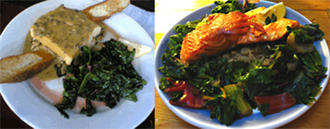 |
| Potato-soy pie with chard. Photo courtesy: George Kelly., and Chard-salmon recipe. (Photo-by selena) |
As in spinach, chard leaves should be washed thoroughly in clean running water and rinsed in saline water for about 30 minutes in order to remove sand, dirt, and any insecticide/fungicide residues.
Here are some serving tips:
Fresh young chard leaves can be used raw in salads.
Mature chard leaves and stalks are typically cooked, braised, or sautéed; the bitter flavor fades with cooking. However, antioxidant properties of chard may significantly diminish on steaming, frying, and boiling for long periods.
Silverbeet pie, with pistachio, raisins, cheese stuffing (filling) is a favorite Italian and Mediterranean region.
Safety profile
Because of its high vitamin-K content, patients on anticoagulant therapy such as warfarin are encouraged to avoid chard in the food since it increases the vitamin-K concentration in the blood, which is what the drugs are often attempting to lower. It, thus, effectively raises the dose of the medicine and may cause overdosage toxicity.
Swiss chard contains oxalic acid, a naturally occurring substance found in some vegetables, which may crystallize as oxalate stones in the urinary tract. Therefore, people with genetic susceptibility to oxalate stones are advised to avoid chard in their diet. Adequate intake of water is encouraged to maintain normal urine output. (Medical disclaimer).
≺≺ Back to Vegetables from Swiss Chard nutrition. Visit here for an impressive list of vegetables with complete illustrations of their nutrition facts and health benefits.
≺≺ Back to Home page.
Further reading: