Pumpkin Nutrition facts
Pumpkin fruit is one of the widely grown winter-squash vegetables incredibly rich in vital antioxidants and vitamins. Though this humble backyard vegetable is low in calories, nonetheless it is packed with vitamin-A, and flavonoid polyphenolic antioxidants such as lutein, xanthin, and carotenes in abundance.
Pumpkin is a fast-growing vine that creeps on the ground in a similar fashion to that of other Cucurbitaceae family vegetables and fruits such as cucumber, squash, cantaloupes, etc. It is one of the most popular field crops cultivated around the world, including in the US at commercial scale for its fruit, and seeds.
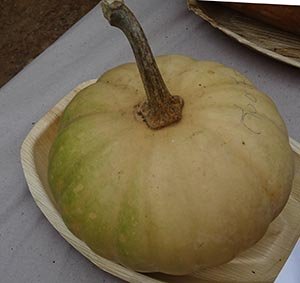 |
| Mature pumpkin fruit. |
Pumpkins vary widely in shape, size, and color. Giant Pumpkins weigh 4–6 kg with the largest capable of reaching a weight of over 25 kg. Golden-nugget pumpkins are flat, smaller, and feature sweet, creamy orange color flesh.
Pumpkins, in general, feature orange or yellow exterior skin color; however, some varieties can exhibit dark to pale green, brown, white, red, and gray. Yellow-orange pigments largely influence their color characteristics in their skin and pulp. Its thick rind is smooth with light, vertical ribs.
In structure, the fruit features golden-yellow to orange flesh depending upon the polyphenolic pigments in it. The fruit has a hollow center, with numerous small, off-white colored seeds interspersed in a net-like structure. Pumpkin seeds are an excellent source of protein, minerals, vitamins, and omega-3 fatty acids.
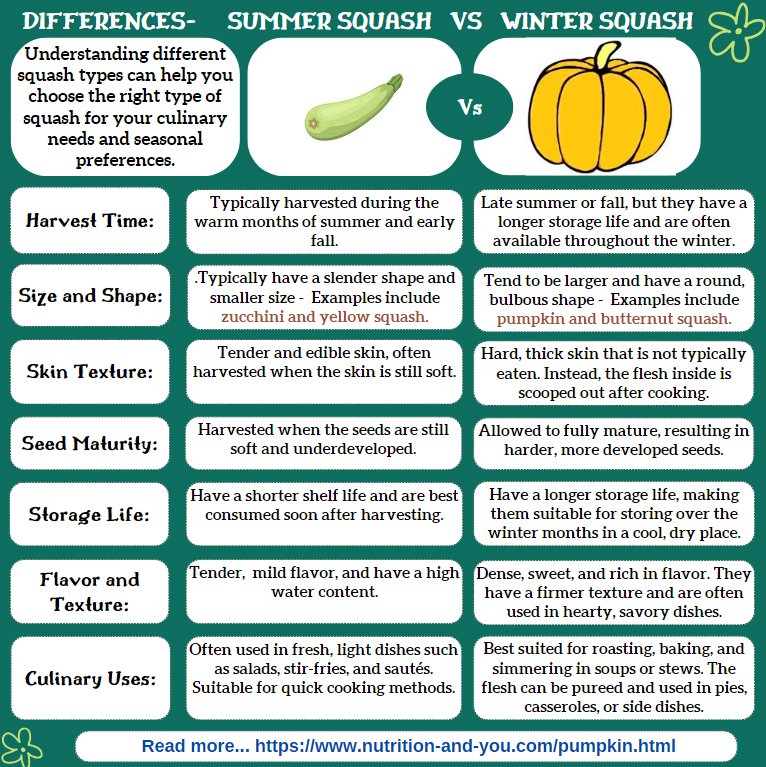
See the differences between Summer and Winter variety squashes in an infographic:
 |
Health Benefits of Pumpkin
It is one of the very low-calorie vegetables. 100 g fruit provides just 26 calories and contains no saturated fats or cholesterol; however, it is rich in dietary fiber, anti-oxidants, minerals, and vitamins. Vegetable is one of the food items recommended by dieticians in cholesterol-controlling and weight-reduction programs.
Pumpkin is a storehouse of many anti-oxidant vitamins such as vitamins A, C, and E.
At 7,384 mg per 100 g, it is one of the vegetables in the Cucurbitaceae family featuring the highest levels of vitamin-A, providing about 246% of RDA. Vitamin A is a powerful natural antioxidant and is required by the body for maintaining the integrity of skin and mucosa. It is also an essential vitamin for good eyesight. Research studies suggest that natural foods rich in this vitamin can help humans protect against lung and oral cavity cancers.
It is also an excellent source of many natural poly-phenolic flavonoid compounds such as α, ß-carotenes, cryptoxanthin, lutein, and zeaxanthin. Carotenes convert into vitamin A inside the human body.
Zea-xanthin is a natural antioxidant that has UV (ultra-violet) rays filtering actions in the macula lutea in the retina of the eyes. Thus, it may offer protection from "age-related macular disease" (ARMD) in older adults.
The fruit is a good source of the B-complex group of vitamins like folates, niacin, vitamin B-6 (pyridoxine), thiamin, and pantothenic acid.
It is also a rich source of minerals like copper, calcium, potassium, and phosphorus.
Pumpkin seeds Pumpkin seeds indeed are an excellent source of dietary fiber and mono-unsaturated fatty acids, which are good for heart health. Also, the seeds are concentrated sources of protein, minerals, and health-benefiting vitamins. For instance, 100 g of pumpkin seeds provide 559 calories, 30 g of protein, 110% RDA of iron, 4987 mg of niacin (31% RDA), selenium (17% of RDA), zinc (71%), etc., but zero cholesterol. Further, the seeds are an excellent source of health-promoting amino acid tryptophan. Tryptophan is converted into GABA in the brain.
| Principle | Nutrient Value | Percent of RDA |
|---|---|---|
| Energy | 26 Kcal | 1% |
| Carbohydrates | 6.50 g | 5% |
| Protein | 1.0 g | 2% |
| Total Fat | 0.1 g | 0.5% |
| Cholesterol | 0 mg | 0% |
| Dietary Fiber | 0.5 g | 2% |
| Vitamins | ||
| Folates | 16 μg | 4% |
| Niacin | 0.600 mg | 4% |
| Pantothenic acid | 0.298 mg | 6% |
| Pyridoxine | 0.061 mg | 5% |
| Riboflavin | 0.110 mg | 8.5% |
| Thiamin | 0.050 mg | 4% |
| Vitamin A | 7384 IU | 246% |
| Vitamin C | 9 mg | 15% |
| Vitamin E | 1.06 mg | 7% |
| Vitamin K | 1.1 mcg | 1% |
| Electrolytes | ||
| Sodium | 1 mg | 0.5% |
| Potassium | 340 mg | 7% |
| Minerals | ||
| Calcium | 21 mg | 2% |
| Copper | 0.127 mg | 14% |
| Iron | 0.80 mg | 10% |
| Magnesium | 12 mg | 3% |
| Manganese | 0.125 mg | 0.5% |
| Phosphorus | 44mg | 5% |
| Selenium | 0.3 mcg | <0.5% |
| Zinc | 0.32 mg | 3% |
| Phyto-nutrients | ||
| Carotene-α | 515 mcg | -- |
| Carotene-ß | 3100 mcg | -- |
| Crypto-xanthin-ß | 2145 mcg | -- |
| Lutein-zeaxanthin | 1500 mcg | -- |
Selection and storage
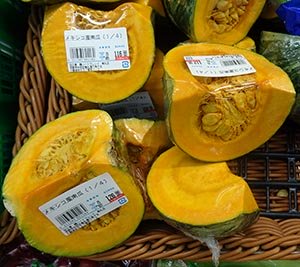 |
| Pumpkin cut section in Japan market |
Pumpkins can be readily available in the market year-round. Buy completely developed, whole pumpkin fruit instead of its sections. Look for mature fruit that features a fine woody note on tapping, heavy in hand, and stout stem. Avoid the ones with wrinkled surfaces, cuts, and bruises.
Once at home, ripe, mature pumpkin may be stored for many weeks to come under a cool, well-ventilated place at room temperature. However, cut sections should be placed inside the refrigerator where it can keep well for a few days.
Preparation and serving methods
Some hybrid varieties are usually subjected to insecticide powder or spray. Therefore, wash them thoroughly under running water in order to remove dirt, soil, and any residual insecticides/fungicides.
Cut the stem end, and slice the whole fruit into halves. Remove the inner mesh-like tissue and set aside the seeds. Then cut the flesh into desired sizes. In general, small, uniform wedges are preferred in cooking.
Almost all the parts of the pumpkin plant; fruit, leaves, flowers, and seeds, are edible.
Here are some serving tips:
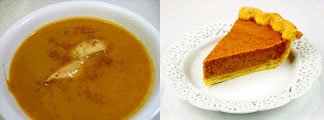 |
| Delicious pumpkin soup and pie! Photos TheCulinaryGeek, and dasqfamily |
Pumpkin can be employed in a variety of delicious recipes either baked, stew- or fried; however, it is eaten best after steam-cooking in order to get maximum nutrients. In China, young tender, pumpkin leaves are consumed as cooked greens or in soups.
In the Indian subcontinent where it is popular as "kaddu or sitaphal," pumpkin is used in the preparation of "sabzi," sweet dishes (halwa), desserts, soups, curries, etc.
-
The fruit employed in the preparations of pies, pancakes, custard, ravioli, etc., in Europe and the US.
Golden nugget pumpkins are used to make wonderful soufflés, stuffing, soups, etc.
Roasted Pumpkin seeds (Pepita) can be eaten as snacks.
Safety profile
Allergic reactions to pumpkins are rare. Pregnant women and infants can safely consume it. (Medical disclaimer).
Also read ≻≻-
≺≺ Pumpkin seeds nutrition facts.
≺≺ Acorn squash nutrition facts and health benefits.
≺≺ Spaghetti squash nutrition facts and health benefits.
≺≺ Back to Vegetables from Pumpkin. Visit here for an impressive list of vegetables with complete illustrations of their nutrition facts and health benefits.
≺≺Back to Home page.
Further reading:
Stanford School of Medicine Cancer information Page- Nutrition to Reduce Cancer Risk (Link opens in new window).
Pumpkins -University of Agriculture Extension.