Plums Nutrition facts
Wonderfully delicious and juicy, plums botanically belong to the Rosaceae family of "drupe" fruits in the genus, Prunus. Other fellow Prunus members include peaches, nectarine, almonds, and damson. Scientific name: Prunus domestica.
The plant is best described as a small tree or large shrub. It is widely cultivated at commercial scale in the United States, Europe, Japan, and China. Several cultivars of plums are grown all over the world which differ in their color, size, and growth characteristics. Generally, each variety of the plum tree bears numerous, almost same-sized berries between May and September months.
 |
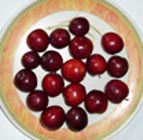 |
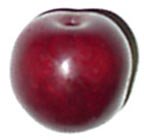
| Plum, close view. | Fresh plum fruits in a tray. |
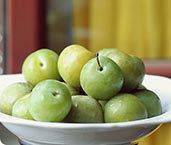
Plums are about the size of an average tomato, measuring about 5-6 cm in diameter and weighing about 50-70 g. It features central umbilicated depression at the stem end. Internally, its pulp is sweet, juicy, and succulent and varies widely from creamy yellow (Mirabelle), crimson, light-blue or light-green (greengages or Reine Claude plums) in color depending upon the cultivar type.
|
 |
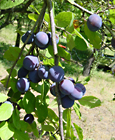
| Plums!. Note for white, surface bloom. Photo courtesy: brankomaster |
Greengages! Photo courtesy: Rowena |
As with other members of the "drupe" family fruits, plums also feature a centrally placed single, smooth, flat, but hard pit. Seeds are inedible.
Plums have a sweet and tart taste with a pleasant aroma. Some of the other common cultivars are cherry plum, damson, and blackthorn plum.
Health Benefits of Plums
Plums are low in calories (46 calories per 100 g) and contain no saturated fats; however, they hold numerous health-promoting compounds, antioxidants, minerals, and vitamins.
Certain health-benefiting compounds present in the plums such as dietary fiber, sorbitol, and isatin have been found to help regulate the smooth digestive system functioning, and thereby, help relieve constipation problems.
The total antioxidant strength of plums measured in terms of ORAC (Oxygen radical absorbance capacity) is 6259 µmol TE/100 g. Fresh berries are a modest source of vitamin-C which is also a powerful natural antioxidant. Consumption of foods rich in vitamin C helps the body develop resistance against infectious agents, counter inflammation, and scavenge harmful free radicals.
Fresh plums, especially yellow mirabelle, are a moderate source of vitamin-A and β -carotene. Vitamin A is essential for good eyesight. It is also required for maintaining healthy mucosa and skin.
Consumption of natural fruits rich in vitamin A has been found to protect from lung and oral cavity cancers.
The fruit also has health-promoting flavonoid polyphenolic antioxidants such as lutein, cryptoxanthin, and zeaxanthin in significant amounts. These compounds help act as scavengers against oxygen-derived free radicals and reactive oxygen species (ROS) that play a role in aging and various disease processes.
Zeaxanthin, an important dietary carotenoid selectively absorbed into the retinal macula lutea where it is thought to provide antioxidant and protective UV light-filtering functions.
Plums are plentiful in minerals like potassium, fluoride, and iron. Iron is required for red blood cell formation. Potassium is an important component of cells and body fluids that helps control heart rate and blood pressure.
Also, they are modest sources of B-complex groups of vitamins such as niacin, vitamin B-6, and pantothenic acid. These vitamins act as cofactors to help the body metabolize carbohydrates, protein, and fats. They also provide about 5% RDA levels of vitamin K. Vitamin K is essential for the functioning of many clotting factors in the blood vessels as well as in bone metabolism. It also helps in limiting the neuronal damage in Alzheimer's disease patients.
| Principle | Nutrient Value | Percent of RDA |
|---|---|---|
| Energy | 46 Kcal | 2.3% |
| Carbohydrates | 11.42 g | 8% |
| Protein | 0.70 g | 1% |
| Total Fat | 0.28 g | 1% |
| Cholesterol | 0 mg | 0% |
| Dietary Fiber | 1.40 g | 3.5% |
| Vitamins | ||
| Folates | 5 µg | 1% |
| Niacin | 0.417 mg | 3% |
| Pantothenic acid | 0.135 mg | 3% |
| Pyridoxine | 0.029 mg | 2% |
| Riboflavin | 0.026 mg | 2% |
| Thiamin | 0.028 mg | 2% |
| Vitamin A | 345 IU | 11.5% |
| Vitamin C | 9.5 mg | 16% |
| Vitamin E | 0.26 mg | 2% |
| Vitamin K | 6.4 µg | 5% |
| Electrolytes | ||
| Sodium | 1 mg | 0% |
| Potassium | 157 mg | 3% |
| Minerals | ||
| Calcium | 6 mg | 0.6% |
| Copper | 0.057 mg | 6% |
| Iron | 0.17 mg | 2% |
| Magnesium | 7 mg | 2% |
| Manganese | 0.052 mg | 2% |
| Phosphorus | 16 mg | 2% |
| Selenium | 1.0 µg | 2% |
| Zinc | 0.10 mg | 1% |
| Phyto-nutrients | ||
| Carotene-ß | 190 µg | -- |
| Crypto-xanthin-ß | 35 µg | -- |
| Lutein-zeaxanthin | 73 µg | -- |
Selection and storage
Plums can be available year-round, but they are at their best between May and September. In the stores, look for fresh fruits featuring rich color and may still have a slight whitish "bloom" on their surface, an indication of a fresh harvest.
Avoid those with excess softness or with cuts or bruises. Ripe fruits just yield to gentle pressure and should feature a sweet aroma.
Slightly hard, but mature plums can be kept at room temperature until they completely ripen. Once ready, place them in the refrigerator, but should be brought back to room temperature just before eating them, which brings out their rich, natural flavor.
Store dry plums (prunes) at room temperature for a few days.
Preparation and serving method
Wash plums in cold running water just before using. Fresh ripe plum can be enjoyed as is, with its peel.
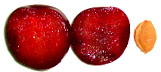 |
| Cut section and pit. |
Incise lengthwise deep into the flesh until its hard seed resistance is felt, and then remove the pit. The skin may be peeled off using a paring knife as in apples. However, its peel not only provides good fiber but also carries some health-benefiting antioxidant pigments. Therefore, just wash the fruit and enjoy it without discarding the peel. You can also bake or stew them!
Here are some serving tips:
Plum sections can be a great addition to salads.
The fruits are being used in the preparation of pies, desserts, jams, and jellies.
They can also be used in a variety of recipes and are usually baked or poached.
Dried plums, in general, known as prunes, can be added to muffins, cakes, ice-creams, etc., as in other dry fruits like raisins, apricots, and figs.
Safety profile
Plums contain oxalic acid, a naturally occurring substance found in some fruits and vegetables, which may crystallize as oxalate stones in the urinary tract in some individuals. Therefore, people with known oxalate urinary tract stones are advised to avoid eating plums. Adequate intake of water is advised to maintain normal urine output even if these people want to eat them. (Medical disclaimer).
≺≺ Read Prunes nutrition facts and health benefits.
≺≺ Back to Fruits from Plums. Visit here for an impressive list of all varieties of fruits with complete illustrations of their nutrition facts and health benefits.
≺≺ Back to Home page.
Further reading and Resources:
Stanford School of Medicine Cancer information Page- Nutrition to Reduce Cancer Risk.