Leeks Nutrition facts
Pleasant, delicate sweet flavored leeks are cylindrical leafy stalks obtained from the onion-family plant, in the Allium genus. They are biennial, tall, slender herbs with a long cylindrical stem composed of concentric layers of overlapping leaves. They are commonly employed as vegetables in stir-fries in many parts of Asia, Europe, and America.
Botanically, leek belongs to the Alliaceae family of bulbous plants, in the genus: Allium. However, unlike their fellow allium members such as onion, shallots, garlic, etc., they do not form underground bulbs.
Scientific name: Allium ampeloprasum var. porrum.
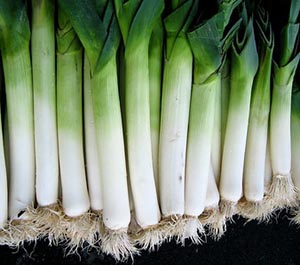 |
| Beautiful leek stalks! Courtesy: muffet |
Leek requires well-drained, fertile soil to flourish. In general, it is cultivated as an annual crop in many parts of Europe and Asia. Farmers either sow seeds or transplant already raised seedlings set in the field that takes about 100-120 days to harvest.
In general, leeks are planted in deep trenches to deprive them of sunlight which otherwise would turn their stalks green (chlorophyll pigmentation) due to photosynthesis. As the plant grows in height, farmers gradually fill the trench by pulling the surrounding earth to create a mound around the stalk. This method was applied in order to obtain long, white, sweet, and blanched stalks instead of green, sharp, and pungent ones.
Health Benefits of Leeks
Leek contains many unique flavonoid antioxidants, minerals, and vitamins that have proven health benefits.
Leeks are moderately low in calories. 100 g fresh stalks carry 61 calories. Further, their elongated stems provide good amounts of soluble and insoluble fiber.
Though leeks contain proportionately fewer thiosulfonates than that garlic; they still possess significant amounts of these groups of antioxidants such as diallyl disulfide, diallyl trisulfide, and allyl propyl disulfide. The compounds convert to allicin by the enzymatic reaction when the leek stalk is subjected to crushing, cutting, etc. The total measured antioxidant strength (ORAC value) of 100 grams of the leek is 490 TE (Trolox Equivalents).
Laboratory studies show that allicin reduces cholesterol formation by inhibiting the HMG-CoA reductase enzyme in the liver cells. Further, it was also found to have antibacterial, antiviral, and anti-fungal activities.
Additionally, allicin reduces blood vessel stiffness by facilitating nitric oxide (NO) release in the vessel wall, and, thereby brings a reduction in the total blood pressure. It also blocks platelet clot formation and has fibrinolytic action (clot-breaking) in the blood vessels. Thus, allicin helps decrease the overall risk of coronary artery disease (CAD), peripheral vascular diseases (PVD), and stroke.
Leeks are an excellent source of vitamins that are essential for optimum health. Their leafy stems indeed contain several vital vitamins such as pyridoxine, folic acid, niacin, riboflavin, and thiamin in the right proportions. 100 g fresh stalks provide 64 µg of folates. Folic acid is essential for DNA synthesis and cell division. Their adequate levels in the diet during pregnancy can help prevent neural tube defects in newborn babies.
Additionally, leeks are one of the good sources of vitamin-A (1667 IU or 55% of RDA per 100 g) and other flavonoid phenolic antioxidants such as carotenes, xanthin, and lutein. They also have some other essential vitamins such as vitamin C, K, and vitamin E. Vitamin C helps the human body develop resistance against infectious agents and scavenge harmful, pro-inflammatory free radicals.
Further, its stalks hold small amounts of minerals such as potassium, iron, calcium, magnesium, manganese, zinc, and selenium.
| Principle | Nutrient Value | Percent of RDA |
|---|---|---|
| Energy | 61 Kcal | 2% |
| Carbohydrates | 14.15 g | 11% |
| Protein | 1.50 g | 3% |
| Total Fat | 0.30 g | 1% |
| Cholesterol | 0 mg | 0% |
| Dietary Fiber | 1.8 g | 5% |
| Vitamins | ||
| Folates | 64 µg | 16% |
| Niacin | 0.400 mg | 2.5% |
| Pantothenic acid | 0.140 mg | 3% |
| Pyridoxine | 0.233 mg | 18% |
| Riboflavin | 0.030 mg | 2% |
| Thiamin | 0.060 mg | 5% |
| Vitamin A | 1667 IU | 55% |
| Vitamin C | 12 mg | 20% |
| Vitamin E | 0.92 mg | 6% |
| Vitamin K | 47 µg | 39% |
| Electrolytes | ||
| Sodium | 20 mg | 1% |
| Potassium | 180 mg | 4% |
| Minerals | ||
| Calcium | 59 mg | 6 % |
| Copper | 0.120 mg | 13% |
| Iron | 2.10 mg | 26% |
| Magnesium | 28 mg | 7% |
| Manganese | 0.481 mg | 2% |
| Phosphorus | 35 mg | 5% |
| Selenium | 1 µg | 2% |
| Zinc | 1.2 mg | 11% |
| Phyto-nutrients | ||
| Carotene-ß | 1000 µg | -- |
| Crypto-xanthin-ß | 0 µg | -- |
| Lutein-zeaxanthin | 1900 µg | -- |
Selection and storage
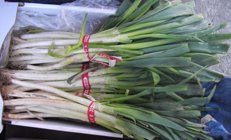
|
| Fresh leeks in a market. |
Leeks are available at their best during the spring season. However, they can be available fresh year-round in most supermarkets. While buying, choose fresh organic leeks as they are rich in flavor and nutrition. Look for uniform, long, firm, ice-white stalks with healthy root bulbs as they indicate fresh farm produce.
Avoid stems with withered, yellow discolor tops.
Once at home, wrap them in a paper towel and place them in the refrigerator where they stay fresh for up to a week or so.
Preparation and serving methods
Leeks impart a mellow, sweet onion flavor to the dishes they add to. They exude less pungency than garlic or onions. Although used sparingly outside the European continent, their delicate stems have recently found favor among Far-East Asian and Mediterranean cuisine.
To prepare; remove its lush top greens. Similarly, trim away the lower root end. In a large bowl of water, swish the stalk gently to remove any surface grit, sand, and soil. Drain and mop dry using a paper towel.
Peel their outer layers by hand. You may want to cut them into rings, slice lengthwise, or in squares using a knife depending on the recipes to prepare.
Here are some serving tips:

|
| Leeks-potato soup. Photo courtesy: Irina |
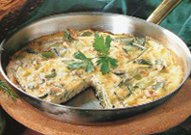
|
| Leek zucchini cheese fritata. (Photo from the essential vegetarian cookbook.) |
Sliced baby leeks and young tender regular stems can be used raw in salads.
They mix well, especially with vegetables, cream, butter, cheese, seafood, and eggs.
Its delicate stems are one of the most sought after particularly in stews and soups. Potato-leek soup is a favorite Northern-European winter preparation, especially by British, and French (vichyssoise).
Julienned blanched (white) leeks used in the preparation of quiche with added leafy rocket (arugula) and herbs like basil.
They can also be employed in the frittata, pizza, and pasta, and like spring onions in noodles, fried rice, pulao, etc., in mouth-watering stir-fries.
Safety profile
Unlike other Allium species like onion, leeks carry less allyl sulfide gas and therefore, cause milder irritation to skin, mucosa, and eyes. (Medical disclaimer).
≻≻-Back to Vegetables from Leeks. Visit here for an impressive list of vegetables with complete illustrations of their nutrition facts and health benefits.
≻≻-Back to Home page.
Further Resources:
USDA National Nutrient Database. (opens new window)
University of Arkansas- Agriculture Extension. pdf (Link opens in new window).
Growing leeks-University of Minetosa Extension Service.