Canola oil Nutrition fact
Canola oil obtained from pressing canola seeds and oil rapeseeds. Both canola seeds and rapeseeds belong to the exactly same Brassica genus; however, the name Canola (Canadian oilseed- low acid) coined for modified plant developed by Canadian scientists. The scientists applied traditional plant breeding methods to get rid of rapeseed’s undesirable qualities – erucic acid and glucosinolates. Both rapeseed and canola plants are, therefore, belongs to the same genus of the crucifer family called Brassica; the large family of plants which also includes turnip, mustard, Brussels sprouts, cabbage, kale, cauliflower, broccoli, etc.
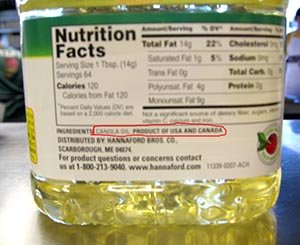 |
| Canola oil. Note carefully for the authentic brand label. Photo: By jdickert |
Canada, the USA, and the European Union are chief producers of rapeseed. In general, edible oil pressed from seeds of rapeseed plants is referred to by different names as canola oil, rapeseed 00 oil, low erucic acid rapeseed oil, LEAR oil, and rapeseed canola-equivalent oil…etc. Present-day edible rapeseed oil is limited by government regulations to a maximum of 2% erucic acid by weight in the US and 5% in the EU.

|
| Brassica napus. Canola field. |
Brassica napus or rapeseed plant is a cool-season small annual flowering herb with deep taproots. It grows to about 4-6 feet in height and bears golden-beautiful yellow flowers, which eventually develop into seedpods measuring about 5 cm in length. Each seedpod holds 20 to 35 tiny, round mustard-like seeds. The seeds carry about 40% of the oil.
Physical characteristics of canola oil
Canola oil is light yellow and neutral in taste. In general, canola seeds are pressed either by traditional cold-pressing methods or on a large scale by the hexane extraction method. The color, taste, and odor of cold-pressed oil indeed is more pronounced than that of refined oil.
Its specific gravity @ 25 °C is 0.916-0.921. Iodine value-110–120; and saponification values-188-198.
Canola oil nutrition facts
Being fat, canola oil is high in energy; 100 g of oil provides 884 calories. However, its high ratio of monounsaturated fatty acids to saturated fatty acids makes it one of the healthy oil for consumption.
-
It is one of the cooking oils with a high smoke point; of 450 ° F. This property can be exploited in setting oil temperature high while deep-frying food items. Canola oil has a very good lipid profile. It has a good distribution of saturated, monounsaturated, and polyunsaturated (SFA: MUFA: PUFA= 8: 61: 31) fats in healthy proportions. Cold-pressed oil is one of the stable cooking oils possessing a very long shelf life.
Health benefits of canola oil
Canola oil possesses unique health benefits than many other vegetable oils and is fast emerging as one of the healthiest oils in tandem with olive oil.
Like olive oil, canola also has very low saturated fats. It contains linoleic (omega-6) and a-linolenic acid (omega-3) essential fatty acids at a 2:1 ratio, marking it as one of the healthiest cooking oils.
It has highest levels of plant sterols, especially ß-sitosterol and campesterol. The US FDA has approved the following claim for phytosterols: "Foods containing at least 0.4 gram per serving of plant sterols, eaten twice a day with meals for a daily total intake of at least 0.8 gram, as part of a diet low in saturated fat and cholesterol, may reduce the risk of heart disease."
Phyto-sterols competitively inhibit cholesterol absorption in the gut and thereby can reduce cholesterol levels by 10% to 15%.
Canola oil is high in calories. However, its high-calorie content comes from better fats. It is especially rich in mono-unsaturated fatty acids (MUFA) like oleic acid (18:1) which constitutes about 61% of total fats. MUFA helps in lowering LDL or "bad cholesterol" and increases HDL or "good cholesterol" in the blood.
Research studies suggest that the Mediterranean diet which is very rich in monounsaturated fatty acids helps prevent coronary artery disease and strokes by favoring a healthy blood lipid profile.
It contains valuable amounts of anti-oxidant vitamin E, particularly gamma-tocopherol. 100 g fresh oil has 27.34 µg of a-tocopherol and 17.46 µg of alpha-tocopherol. Vitamin E is a powerful lipid-soluble antioxidant, required for maintaining the integrity of cell membrane of mucus membranes and skin by protecting it from harmful oxygen-free radicals.
Canola oil has the highest smoke point oil and is also an ideal choice for deep frying because it can be heated to a higher temperature (smoke point -450 °F). This results in less oil retention in the fried foods.
| Principle | Nutrient Value | Percent of RDA |
|---|---|---|
| Energy | 884 Kcal | 44% |
| Carbohydrates | 0 g | 0% |
| Protein | 0 g | 0% |
| Total Fat | 100 g | 500% |
| Cholesterol | 0 mg | 0% |
| Dietary Fiber | 0 g | 0% |
| Vitamins | ||
| Folates | 0 µg | 0% |
| Niacin | 0 mg | 0% |
| Pantothenic acid | 0 mg | 0% |
| Pyridoxine | 0 mg | 0% |
| Riboflavin | 0 mg | 0% |
| Thiamin | 0 mg | 0% |
| Vitamin-A | 0 IU | 0% |
| Vitamin C | 0 | 0% |
| Vitamin E-γ | 27.34 mg | 182% |
| Vitamin-K | 71.3 µg | 59% |
| Electrolytes | ||
| Sodium | 0 mg | 0% |
| Potassium | 0 mg | 0% |
| Minerals | ||
| Calcium | 0 mg | 0% |
| Copper | 0 mg | 0% |
| Iron | 0 mg | 7 % |
| Magnesium | 0 mg | 0% |
| Manganese | 0 mg | 0% |
| Phosphorus | 0 mg | 0% |
| Selenium | 0 µg | 0% |
| Zinc | 0 mg | <1% |
| Phytonutrients | ||
| Carotene-ß | 0 µg | -- |
| Cryptoxanthin-ß | 0 µg | -- |
| Lutein-zeaxanthin | 0 µg | -- |
| ß-Sitosterol | 413 mg | -- |
Selection and storage
Canola oil sold in the markets with different names, labels, and specifications like, for example, rapeseed 00 oil, low erucic acid rapeseed oil, LEAR oil, and rapeseed canola-equivalent oil, etc. Look carefully for the manufacture date and buy fresh-pressed oil from authentic brands.
Cold-pressed oil has a healthy level of antioxidants and a longer shelf life. Its price tends to be slightly higher because of the lower recovery of oil from the pressed seeds.
Like any other vegetable oil, canola can undergo rancid if kept exposed to heat, moisture, and sunlight. Always store oil in tightly sealed containers and place it in a cool, dark place away from heat or light.
Culinary use
Besides being used commercially as cooking oil, canola is one of the preferred oils in salad dressings, margarine, shortening, deep-frying, baking, spreads, and creamers.
Canola oil features a clear light yellow color with a neutral flavor. It blends with added herbs and spices and allows the flavor of herbs and spices to dominate.
Here are some serving tips
Traditional Burgundian fondue wherein canola oil is used to deep fry meat, chicken, or seafood and enjoyed with sauces like sour cream mustard sauce, Béarnaise sauce, and hollandaise sauce.
Like peanut oil, canola is also the preferred oil used to deep fry turkey.
Safety profile
Several research studies have shown that canola oil can be used safely as edible oil. However, look carefully for the label to make sure that it is free from erucic acid and glucosinolates. Erucic acid is an omega-9 fatty acid that occurs in other Brassica family of plants such as rapeseed, mustard, kale, etc., as well.
Unrefined rapeseed oil contains up to 45% erucic acid. However, the genetically modified canola plant is genetically free of erucic acid and glucosinolate-producing proteins. It is, therefore, food-grade canola oil (also known as rapeseed 00 oil, low erucic acid rapeseed oil (LEAR oil), and rapeseed canola-equivalent oils) that is free from these toxins and safe for human consumption. (Disclaimer).
-Also read≻≻-
≻≻-Olive oil. nutrition facts.
≻≻-Peanut oil. nutrition facts.
≻≻-Soybean oil. nutrition facts.
≻≻-Back to Dietary oils and fats from Canola oil.
≻≻-Back to Home page.
Further Resources:
USDA National Nutrient Database. (opens new window)