Ajwain (carom seeds) Nutrition facts
Flavorful yet sharply pungent, ajwain seeds are one of the traditional spices that commonly feature in Indian and Middle-Eastern cuisine. Botanically, they are the spicy seeds belonging to the family of Apiaceae (Umbelliferae), in the genus; Trachyspermum. Scientific name: Trachyspermum copticum.
The Umbellifers are small flowering shrubs (same as the members of carrot or parsley family) which also include a broad category of herbs and spice plants such as parsley, dill, fennel, aniseed, and caraway. Some of the common names for ajwain seeds are ajowan seeds, carom seeds, etc.
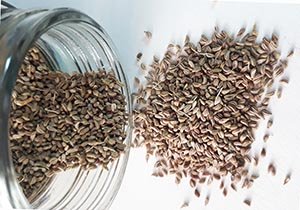 |
| Ajowan or carom seeds. Note for ovoid, light brown seeds. |
The Trachyspermum copticum (ajwain) is thought to have originated in the Asia Minor or Persia regions, from where it spread to the Indian subcontinent. The plant is a small, cool-season annual herb that grows up to two to three feet in height. It features tiny white-petaled flowers in umbels that eventually develop into small, oval-shaped seeds. The crop is ready for harvesting by the end of winter or early spring.
Ajwain seeds are olive-green to brown in color and have a similarity in appearance to cumin or caraway seeds, marked with vertical stripes on their outer surface. However, they can be easily distinguished from caraway and cumin by their elliptical shape and tiny size. Their flavor closely resembles that of thyme since they too comprise essential oil, thymol.
Health benefits of Ajwain
Ajwain seeds contain health-benefiting essential oils such as thymol, a monopterone derivative class of chemical compound that gives aromatic fragrances to seeds. Besides, they also composed of small amounts of other phytochemicals such as pinene, cymene, limonene, and terpinene.
The active principles in the ajwain may help increase the digestive function of the intestinal tract by facilitating the release of gut juices (gastro-intestinal secretions).
Thymol, the essential oil obtained from ajwain has local anesthetic, antibacterial, and antifungal properties.
Likewise in caraway, ajowan seeds are a rich source of fiber, minerals, vitamins, and antioxidants.
Facts qoute
Ajwain seeds contain health-benefiting essential oil, thymol; a monopterone derivative class of chemical compound which gives them an aromatic fragrance.
Selection and storage
Ajwain is readily available in spice stores specializing in Indian or Middle-Eastern spice ingredients. In general, whole ajwain seeds are displayed for sale alongside other spices such as dill, cumin, coriander, caraway, etc. Buy fresh, wholesome, compact seeds emanating pleasant thyme-like flavor when rubbed between fingers.
Once at home, store the seeds in an airtight container and place them in a cool dark place away from sunlight and humidity. Ajowan seeds should be used as early as possible since they lose flavor rather quickly, largely because of the evaporation of essential oils.
Medicinal uses
Ajwain seeds have long been in use in traditional Ayurvedic and Unani medicines as a cure for various ailments. The spice extraction is often used as a carminative to treat flatulence and indigestion.
Thymol's germicide and antiseptic properties can be reaped in the preparation of cold and cough remedies. In India, ajwain seed decoction is often used to relieve asthma episodes.
Ajwain seed oil has the highest percentage of thymol.
Ajwain water is recommended as a remedy for weight control in Ayurvedic medicine. To prepare, soak 20g of ajwain seeds in a glass of water overnight. The next morning, strain the water and add one teaspoonful of honey. Ajwain water also cleanses the digestive system and improves metabolism. (Medical disclaimer).
Culinary uses
Ajwain seeds mainly feature in savory Indian, Pakistani, and Middle-Eastern cooking. In general, the seeds are ground just before preparing dishes and added to the recipes in the final stages to keep the fragrance and flavor of the food intact. Prolonged cooking may result in the evaporation of its essential oils.
In Punjab province of India and Pakistan, the spice seeds notably added to make bread, ajwain parantha.
Some Indian vegetarian bean/lentil and chicken/fish curries contain this spice, and in the Middle East, it is used to flavor meat and rice dishes.
Ajowan seeds are used generously as a condiment in snacks, savory biscuits, cookies, flavor drinks, soups, and sauces in India.
- They also used in pickling along with fenugreek, mustard seeds, turmeric, etc.
Safety profile
Additionally, the consumption of dishes prepared using this spice may be avoided in individuals with liver diseases, ulcerative colitis, and diverticulitis conditions. (Medical disclaimer).
≺≺- Back to Spices from Ajwain. Visit here for an impressive list of healthy spices with complete illustrations of their nutrition facts and health benefits.
≺≺- Back to Home page.
Further reading:
Gernot Katzar's Spice pages (opens in new window).