Stevia plant (herb) Nutrition facts
Stevia plant is a small, sweet, leafy herb of South American origin.
Is stevia a safe alternative to the common sugar in a carbohydrate-controlled diet? Does it have any real phytonutrient profile safe enough for human consumption in line with other herbs such as basil, mint, thyme, etc.?
The use of Stevia as a culinary herb was known to the native Guarani tribes of Paraguay for centuries. Recent scientific trials firmly establish that this sweetleaf herb has, indeed, many health-benefiting plant-derived phytochemical compounds that help control blood sugar, cholesterol, and blood pressure in addition to its worth as a natural sweetener. Together with the rise in demand for low-calorie food alternatives, stevia has drawn the attention of health-conscious fitness lovers all over the planet.
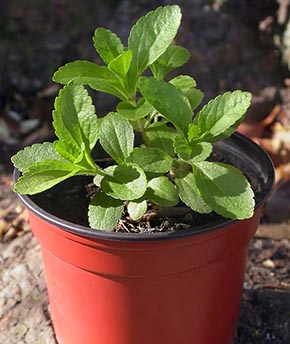 |
| Stevia plant (Stevia rebaudiana). Note deep-green, serrated leaves. Photo courtesy: Grabiela Ruellan |
Stevia is a small perennial herb belonging to the Asteraceae family, in the genus Stevia. Its scientific name is Stevia rebaudiana. Some commonly referred names are honey leaf plant, sweet chrysanthemum, sweetleaf stevia, sugarleaf, etc.
Stevia plant grows 2-4 feet in height with slender, branched stems, and flourishes well all over the temperate and some parts of tropical regions. It is being cultivated on a commercial scale in Japan, China, Thailand, Paraguay, and Brazil. Today, China is the leading exporter of stevia products.
|
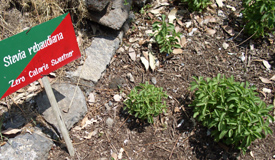
| Stevia plant (Stevia rebaudiana). |
Almost all the parts of the plant taste sweet; however, the sweet glycosides are typically concentrated in its dark green, serrated leaves. The Guarani Indians of Paraguay have used its leaves to sweeten drinks and foods, and also to sweeten bitter-tasting traditional medicines. In modern times, it is used in foods in many parts of India, East Asian regions, and South American countries.
Health benefits of Stevia
Stevia herb parts are very low in calories. Parts by parts, its dry leaves possess roughly 40 times more sweetness than sugar. This sweetness quality in stevia is due to several glycoside compounds including stevioside, steviolbioside, rebaudioside A-E, and dulcoside.
Stevioside is a non-carbohydrate glycoside compound. Hence, it lacks the properties that sucrose and other carbohydrates possess. Stevia extracts, like rebaudioside-A, are found to be 300 times sweeter than sugar. Besides, being a near-zero calorie food ingredient, stevia extracts have several unique properties such as long shelf life, high-temperature tolerance, and non-fermentative.
Furtehr, stevia plant has many sterols and antioxidant compounds like triterpenes, flavonoids, and tannins. Some of the flavonoid polyphenolic anti-oxidant phytochemicals present in stevia are kaempferol, quercetin, chlorogenic acid, caffeic acid, isoquercitrin, iso-steviol, etc. Studies found that kaempferol can reduce the risk of pancreatic cancer by 23% (American Journal of Epidemiology) [1].
Chlorgenic acid reduces the enzymatic conversion of glycogen to glucose in addition to decreasing the absorption of glucose in the gut. Thus, it helps reduce blood sugar levels. Lab studies also confirm a reduction in blood glucose levels and an increase in the liver concentrations of glucose-6-phosphate, and glycogen.
Certain glycosides in stevia extract have been found to dilate blood vessels and increase sodium excretion, and urine output. In effect, stevia, at slightly higher doses than a sweetener, can help lower blood pressure.
Being a non-carbohydrate sweetener, stevia would not favor the growth of Streptococcus mutans bacteria in the mouth which is attributed to be a causative agent of dental caries and tooth cavities. On the other hand, certain compounds in stevia rather found to inhibit caries-causing bacteria in the mouth.
Further, being an herb, stevia contains many vital minerals, and vitamins that are selectively absent in artificial sweeteners.
Stevia plant uses in traditional medicine
Stevia extract has been in use by native South Americans (where it is known as caa-he-éé or kaa jheéé) to reduce weight; to treat wound infections, inflammatory conditions, swelling in the legs and as a tonic to treat depression.
Selection and storage
|
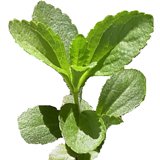
| Fresh stevia leaf. |
At its natural habitat, stevia plant leaves are harvested by hand picking as and when required. However, most of the stevia that is made available in the markets, is grown in the greenhouse, or at least under supervised farming. If you grow your own stevia plant in the backyard, pick up leaves with a short petiole for use. In general, fresh leaves can be sundried, powdered, and stored in an airtight container for future use.
To store, place it in a cool, dark, humid-free place like the one you do for other dried herbs such as oregano, where it will stay fresh for several months.
Preparation and serving methods
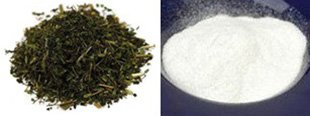 |
| Stevia sugar and Dried stevia leaves. |
Farm fresh stevia plant leaves can be used directly in drinks as a sweetener. However, most often dried powder/ refined stevioside/ stevia syrup is used in the cooking.
Remember to use dried stevia sugar in small proportions, as it is nearly 30 times sweeter than cane sugar. Roughly, one teaspoonful of dried leaves powder is equivalent to one cup of sugar; therefore, use it in small quantities adjusting the amount to achieve your desired levels of sweetness.
You can also make stevia syrup by adding a cup of hot water to 1/4 cup of fresh, finely crushed leaves. This mixture is allowed to settle down for 24 hours, filtered, and then refrigerated. You may also want to buy stevia sugar rebaudioside-A which is a white, crystalline powder, approximately 300 times sweeter than cane sugar.
Here are some serving tips:
In Japan and many East Asian regions, stevia plant parts are being used to sweeten tea, sweets, sauce, confectionary, and soft drinks.
Stevia extracts are further refined for use as table sugar. It can then be added to jam, yogurt, ice creams, smoothies, desserts, chewing gum, and sorbets and also to sweeten bitter medicines.
In Brazil, it is used as a remedy to treat diabetes, high blood pressure, stress conditions, etc.
Safety profile
Stevia plant and its processed products are not being used in the European Union countries for their suspected mutagenic effects. In the USA, stevia leaf and its extract are limited to use legally as a dietary supplement. However, the use of rebaudioside-A, a processed stevia glycoside, is allowed in many of these countries.
In 2006, the World Health Organization (WHO) observed the following statement regarding the use of stevia plant: “stevioside and rebaudioside A are not genotoxic in vitro or in vivo and that the genotoxicity of steviol and some of its oxidative derivatives in vitro is not expressed in vivo.”[2]
In conclusion, stevia and its products are being used in some advanced countries like Japan and for centuries by Guarani tribes of South America and found to be harmless for human consumption even in pregnancy. (Medical disclaimer).
Accurate Information Regarding the Stevia Plant
Stevia is a herb plant in the Asteraceae family. It is being used in some advanced countries as a safe low-calorie alternative, especially in restricted carbohydrate diets.
It has been safely used by Guarani tribes of Paraguay for centuries without any adverse effects; the fact which is endorsed recently by the World Health Organization.
Further, stevia has many natural antioxidants that help lower blood pressure, and cholesterol, and control diabetes.
Stevia can be safely used during pregnancy and infants. (Medical disclaimer).
≻≻-Also Read..
≺≺ How are artificial sweeteners made?
≺≺ Back to Herbs from Stevia plant. Visit here for an impressive list of all variety of herbs with complete illustrations of their nutrition facts and health benefits.
≺≺ Back to Home page.
Further Resources: