Poppy seeds Nutrition facts
Nutty and pleasant in taste, poppy seeds are nutritious oilseeds used as a condiment in cooking. Although the seeds are obtained from the dry fruits (pods) of the poppy plant (opium poppy), they are entirely free from any harmful side effects of other poppy plant products such as opium poppy.
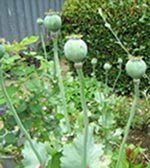
Poppy plant is a biennial herb of East Mediterranean and Asia Minor origin belonging to the Papaveraceae family, in the genus: Papaver. Scientific name: Papaver somniferum.
 |
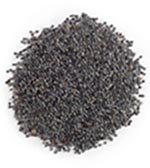 |
| Poppy plant (Papaver somniferum). Note azure color poppy plant with fruit capsules containing poppy seeds. | Black poppy seeds. |
Ancient Egyptians had knowledge of harvesting seeds from the poppy seedheads. Through the Arab traders, opium cultivation spread to Persia, ancient Khorasan, and India.
Today, seeds of the poppy are a well-established commercial crop in many parts of the world including the Czech Republic, Germany, Turkey, France, India, and the East European region.
The poppy plant grows up to 5 feet in height. It requires full sunlight and fertile soil to flourish. Depending upon its variety, lilac, blue, red, or white flowers appear during spring on long peduncles which subsequently turn into globular or oval-shaped fruits (seed capsules).
 |
|
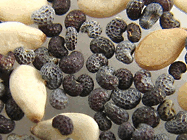
| Close-up view. Compare black poppy seeds with white sesame seeds
size. Also, note for bean-shaped poppy with polygonal surface indentations. Photo courtesy: lenore-m |
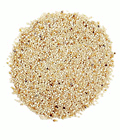
White poppy seeds. |
Each globular poppy fruit head (capsule) measures about 4–6 cm in length and 3–4 cm in diameter and contains numerous tiny, bean (kidney) shaped seeds, which rattle when shaken inside dried capsules. Seeds poppy can be light gray to dark gray, black, or bluish depending on the cultivar type.
Poppy seeds are popular food ingredients, generally employed as a condiment and to press oil. The seeds, indeed, are very safe to use as food and contain negligible quantities of toxic alkaloids of the opium poppy.
Health benefits of Poppy seeds
Poppy seeds compose unique plant-based chemical compounds that have antioxidant, disease-preventing, and health-promoting properties.
Their unique nutty aromatic flavor is because of many fatty acids and essential volatile oils, which comprise about 50% of net weight. The seeds are especially rich in oleic and linoleic acids. Oleic acid, a mono-unsaturated fatty acid, helps lower LDL or "bad cholesterol" and increase HDL or "good cholesterol" levels in the blood.
Research studies suggest that the Mediterranean diet which is rich in monounsaturated fatty acids helps to prevent coronary artery disease and strokes by favoring a healthy blood lipid profile.
Poppy seeds outer husk is a good source of dietary fiber. 100 g raw seeds provide 19.5 g or 51% of the recommended daily levels (RDA) of fiber. Much of this fiber is metabolically inert content which helps increase the bulk of the food by absorbing water down the digestive tract and thereby easing constipation problems.
Additionally, dietary fiber binds to bile salts (a product of cholesterol) and decreases their reabsorption in the colon. It thus helps in a further decrease in blood LDL cholesterol levels.
The seeds are an excellent source of B-complex vitamins such as thiamin, pantothenic acid, pyridoxine, riboflavin, niacin, and folic acid. Many of these vitamins function as co-factors in the substrate metabolism, especially fat and carbohydrates inside the human body.
Poppy seeds contain good levels of minerals like iron, copper, calcium, potassium, manganese, zinc and magnesium. Copper is utilized in the production of red blood cells. Zinc is a co-factor in many enzymes that regulate growth and development, sperm generation, digestion, and nucleic acid synthesis.
Potassium is an important component of cell and body fluids that helps control heart rate and blood pressure. The human body uses manganese as a cofactor for the important antioxidant enzyme, superoxide dismutase.
Dry poppy seeds contain very small levels of opium alkaloids such as morphine, thebaine, codeine, papaverine, etc. When consumed in food, these compounds produce a minimal effect on the human nervous system. On the contrary, these chemicals are found to have some beneficial effects on the human body; soothe nervous irritability, and act as painkillers. Its seed extractions found useful in the pharmacy and many traditional medicines in the preparations of cough mixtures, expectorants, etc.
| Principle | Nutrient Value | Percent of RDA |
|---|---|---|
| Energy | 525 Kcal | 26% |
| Carbohydrates | 28.13 g | 22% |
| Protein | 17.99 g | 32% |
| Total Fat | 41.56 g | 139% |
| Cholesterol | 0 mg | 0% |
| Dietary Fiber | 19.5 g | 51% |
| Vitamins | ||
| Folates | 82 µg | 20% |
| Niacin | 0.896 mg | 5.5% |
| Pantothenic acid | 0.324 mg | 65% |
| Pyridoxine | 0.247 mg | 19% |
| Riboflavin | 0.100 mg | 8% |
| Thiamin | 0.854 mg | 71% |
| Vitamin A | 0 IU | 0% |
| Vitamin C | 1 mg | 2% |
| Vitamin E | 1.77 mg | 12% |
| Vitamin K | 0 mg | 0% |
| Electrolytes | ||
| Sodium | 26 mg | 2% |
| Potassium | 719 mg | 15% |
| Minerals | ||
| Calcium | 1438 mg | 144% |
| Copper | 01.627 mg | 181% |
| Iron | 9.76 mg | 122% |
| Magnesium | 347 mg | 87% |
| Manganese | 6.707 mg | 292% |
| Phosphorus | 870 mg | 124% |
| Selenium | 13.5 µg | 24% |
| Zinc | 7.9 mg | 72% |
Selection and storage
Fresh whole or ground poppy seeds can be readily available in grocery stores. The seeds are high in polyunsaturated fats, which make them vulnerable to oxidation and turn rancid. Therefore, buy good quality whole fresh seeds from the authentic store.
Store seeds poppy in a cool, dry, dark place, in airtight containers where they will stay fresh for up to six months.
Preparation and serving method
Poppy seeds are one of the favorite items in many cuisines. They add a special nutty flavor to the recipes. Their flavor is somewhat augmented by roasting them in a pan under mild heat. Gentle frying releases special aromatic essential oils in the seeds and enhances crunchiness.
Here are some serving methods:
Poppy, in general, is used either in the form of whole seeds, ground or as thick or thin paste in recipes.
 |
| Poppy seed pastry. Photo courtesy:rusvaplauke |
In the same way as sesame, poppy too sprinkled over toasts, bread, seafood.
In India and Pakistan where its seeds are popular as khus khus (खुस खुस), gently fried poppy ground in a mixer to prepare a thin paste which then added as a thickening agent in dips, curries, and sweet dishes.
In South India, poppy seed milk is used to prepare sweet recipes popular as khus khus payasam with added milk, coconut milk, cardamom, raisins, and sugar.
In Central Europe, especially in Austria and Hungary, the seeds are used in s a popular sweet pastry dish like Strudel and Germknodel.
The seeds are widely employed in confectionery like stuffing, rolls, bagels, sweet bread, biscuits, and cakes.
Safety profile
Allergic incidences of Poppy seeds are rare. They can be used safely even in pregnant women and children.
Sports personnel, however, need to keep in mind that they may test false positives when consuming food items containing poppy seeds for banned opiate substances like morphine, codeine, etc. However, these compounds may not be high enough to produce narcotic drug side effects.
(Medical disclaimer: The information and reference guides on this website are intended solely for the general information of the reader. It is not to be used to diagnose health problems or for treatment purposes. It is not a substitute for medical care provided by a licensed and qualified health professional. Please consult your health care provider for any advice on medications.)
≺≺-Back to Nuts and seeds from Poppy seeds. Visit here for an impressive list of nuts with complete illustrations of their nutrition facts and health benefits.
≺≺-Back to Home page.
Further Resources:
Stanford School of Medicine Cancer information Page-Nutrition to Reduce Cancer Risk.