Celery Nutrition facts
Celery is one of the traditional Mediterranean herbs recognized for its strong aromatic flavor that elevates various culinary creations. It is a small biennial herbaceous plant that originated in Europe. It can be grown quickly as a potherb in the home gardens for its flavorful leaves, stalks, roots, and seeds.
Botanically, leaf-celery belongs to the Apiaceae family of herbs, in the genus; Apium. Scientific name: Apium graveolens.
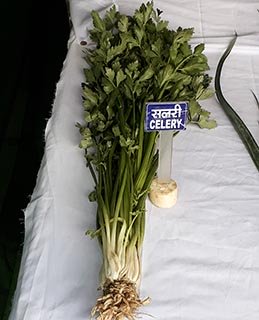 |
| Leaf-celery (Apium graveolens dulce). |
Celery is a petite plant, reaching about half a meter in height, and it requires fertile, moisture-rich soil to flourish.
It bears umbelliform flowers at the top of the stalk in the second year. An edible cluster of long, dark-green, somewhat hollow stems grows upright from the crown of the plant. Its leaves resemble those of flat-leaf parsley. Several cultivars exist:
Celery herb bears umbelliform flowers at the top of the stalk in the second year. An edible cluster of long, dark-green, somewhat hollow stems grows upright from the crown of the plant. Its leaves have a similar appearance to that of flat-leaf parsley. Several cultivars exist:
Wild celery, the parent of the cultivated stalk-celery (A. graveolens dulce),
Leaf-celery (A. graveolens secalinum), and,
Celeriac or knob celery (A. graveolens rapaceum).
Chinese celery or the oriental variety features thin, hollow, succulent stalks. Its leaves and stalks carry a more intense flavor than the continental variety.
Celery seeds, used as a spice, resemble cumin seeds seeds in appearance. They feature a dark-brown color, an oblong shape with thin vertical ridges, and a strongly aromatic flavor.
Health Benefits of Celery
Celery is among the very low-calorie herbaceous plants, with its leaves carrying only 16 calories per 100 g weight and containing lots of non-soluble fiber (roughage), which, when combined with other weight loss regimens, may help reduce body weight and blood cholesterol levels.
Its leaves are a rich source of flavonoid antioxidants such as zeaxanthin, lutein, and ß-carotene, which have antioxidant, cancer-protective, and immune-boosting functions. For this reason, celery has been acknowledged as a functional food.
Its leaves are also a good source of vitamin-A. 100 g of fresh celery comprises 449 IU or 15% of the daily required levels of this vitamin. Vitamin A and beta-carotene are natural flavonoid antioxidants. Vitamin A is also required for maintaining healthy mucosa and skin and for night vision. Consumption of natural foods rich in flavonoids helps the body to protect from lung and oral cavity cancers.
The herb is also rich in many vital vitamins, including folic acid (providing 9% of RDA), riboflavin, niacin, and vitamin C, which are essential for optimum metabolism.
Fresh celery is an excellent source of vitamin-K, providing about 25% of DRI. Vitamin K helps increase bone mass by promoting osteoblastic activity in the bones. It also has an established role in Alzheimer's disease patients by limiting neuronal damage in the brain.
Its leaves and seeds contain many essential volatile oils that include terpenes, mostly limonene (75 to 80%), and the sesquiterpenes like ß-selinene (10%) and humulene; however, its unique fragrance is due to chemical compounds known as phthalides (butylphthalide and its dihydro derivate sedanenolide) in them.
The herb is a very good source of minerals like potassium, sodium, calcium, manganese, and magnesium. Potassium is an important component of cells and body fluids that help regulate heart rate and blood pressure.
Celery contains a special compound called phthalide, especially 3-n-butylphthalide. This compound helps relax the muscles around your blood vessels. When your blood vessels relax and widen, blood can flow more easily, which helps lower blood pressure.
The essential oil obtained from the extraction of the celery plant has been employed as a soothing remedy for nervousness, osteoarthritis, and gouty arthritis conditions. Besides, its seeds and root have diuretic (removes excess water from the body through urine), galactagogue (helps breast milk secretion), stimulant, and tonic properties.
Celery plant holds just 16 calories per 100 g of leaves and, together with numerous health-benefiting phytonutrients such as flavonoids, folate, vitamin-A, vitamin-K, minerals, and other vitamins, has all the characteristics to consider it as one of the most valuable low-calorie or negative calories weight loss functional foods.
| Principle | Nutrient Value | Percent of RDA |
|---|---|---|
| Energy | 16 Kcal | <1% |
| Carbohydrates | 3 g | 5.5% |
| Protein | 3.46 g | 6% |
| Total Fat | 1.12 g | 4.5% |
| Cholesterol | 0 mg | 0% |
| Dietary Fiber | 2.10 g | 5.5% |
| Vitamins | ||
| Folates | 36 µg | 9% |
| Niacin | 0.320 mg | 2% |
| Pantothenic acid | 0.246 mg | 5% |
| Pyridoxine | 0.074 mg | 6% |
| Riboflavin | 0.57 mg | 4% |
| Thiamin | 0.021 mg | 2% |
| Vitamin-A | 449 IU | 15% |
| Vitamin-C | 3.1 mg | 5% |
| Vitamin-K | 29.3 µg | 24% |
| Electrolytes | ||
| Sodium | 80 mg | 5% |
| Potassium | 260 mg | 5.5% |
| Minerals | ||
| Calcium | 40 mg | 4% |
| Copper | 0.35 mg | 4% |
| Iron | 0.20 mg | 2.5% |
| Magnesium | 11 mg | 3% |
| Manganese | 0.103 mg | 4.5% |
| Phosphorus | 24 mg | 3% |
| Zinc | 0.13 mg | 1% |
| Phyto-nutrients | ||
| Carotene-ß | 270 µg | -- |
| Crypto-xanthin-ß | 0 µg | -- |
| Lutein-zeaxanthin | 283 µg | -- |
Selection and Storage
Celery, also known as "smallage," is available in the markets throughout all seasons. Its tender leaves and stems are more sought-after items than its roots and seeds in cooking. To prepare the dry herb (dry leaves), harvest the top 6 to 8 inches of growth just before blooming.
When purchasing from the store, look for fresh leaves and stems featuring a bright green color and a crispy appearance. Avoid any slump, shriveled stems, dry, yellow, or spoiled leaves, as they lack flavor.
At home, the stems can stay fresh for up to a week inside the refrigerator. Wrap them in a paper towel and place them inside a zipped bag. Use the leaves while they are fresh to enjoy their strong aromatic flavor.
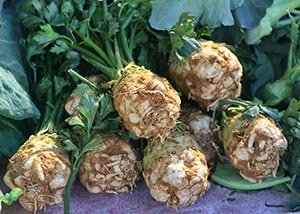 |
| Celeriac. |
Celeriac (Apium graveolens, Rapaceum Group) is a turnip-like root plant closely related to celery, sharing a similar growth habit and general appearance. Its tuber boasts a thick gray-brown outer coat but harbors white, aromatic flesh inside. This root celeriac, used as a vegetable, is quite popular in the United Kingdom.
Celery seeds are typically used either whole or ground, often mixed with salt to create "celery salt."
Preparation and serving methods
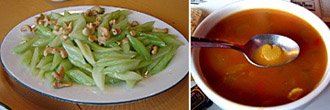 |
| Celery stem stir-fry with cashews. Photo: lobstestew, and Celery soup. Photo: kramerhawks |
Wash the leaves and stems in cold water to remove any surface dirt, fungicides, and pesticides. Due to its high fiber content, remove the tough stem ends and chop the stems and leaves finely to ensure thorough cooking. The leaf tops, roots, and stalks are all utilized in cooking in European and Asian cuisine.
To prepare the root celeriac, trim off its top and base ends, then peel away the tough outer skin using a paring knife. Cut it into cubes or slices and promptly rinse in lemon or orange juice to prevent discoloration (oxidation).
Here are some serving tips:
Fresh leaves, roots, and stalks are utilized in salads and stews.
The herb serves as a garnish in various recipes, complementing vegetables such potato, carrot, beans, and poultry.
Both fresh leaves and roots are incorporated into the preparation of soups and sauces.
Medicinal Uses
Wild celery has historically been utilized in medicine for reducing blood pressure, relieving indigestion, and acting as an anti-inflammatory agent. Additionally, it functions as a diuretic, aiding in the removal of excess water from the body.
The essential oils present in celery seeds, leaves, and roots have been employed for various purposes, including carminative effects, as an emmenagogue, and as a galactagogue to promote breast milk secretion. They have also been used to alleviate nervous system ailments such as headaches and nervous irritability.
The herb has been purported to be beneficial in treating rheumatism and gouty conditions. (Disclaimer)
Safety Profile
The herb, particularly wild celery, can induce severe anaphylactic reactions in sensitive individuals. Pregnant women are advised against its consumption, and those on diuretic or anticoagulant medications should use it sparingly.
Its stalks contain high amounts of both soluble and insoluble fiber. Consuming recipes with excessive fiber content may lead to stomach pain, indigestion, bloating, and can exacerbate existing constipation conditions. (Medical disclaimer).
≻≻-Also Read..
≻≻-Can celery lower my blood pressure?
≻≻-Back to Herbs from Celery. Visit here for an impressive list of all varieties of herbs with complete illustrations of their nutrition facts and health benefits.
≻≻-Back to Home page.
Further Resources:
USDA - Nutrient Database for Standard Reference.
Dietary, Functional, and Total fiber-National agricultural library, USDA-pdf.