Lychee fruit Nutrition facts
Delicious and juicy lychee or "Litchi" heralds the arrival of summer. Besides being sweet and nutritious, these berries bring a cooling effect on the human body to beat the scorching summer heat. Botanically, this exotic fruit belongs to the family of Sapindaceae and is named scientifically as Litchi chinensis.
The L. chinensis is a tropical fruit tree native to the low elevations of the Kwangtung and Fukien provinces in Southern China.
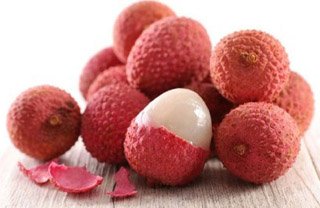 |
| Lychee, Fresh berries |
It is a slow-growing, medium-sized evergreen tree with dense, round-topped foliage and smooth, gray, brittle trunk and branches. It may reach 40 to 50 feet in height.
Litchis are not just eye-catching trees when a huge spray of flowers is adorned during spring but also a stunning sight for fruit-lovers when attractive, maroon-colored berries cover by early summer.
In structure, the fruit is a drupe, oval, heart-shaped, or nearly round, measures about 3 to 5 cm long and 3 cm across, and weighs about 10 g. In appearance, litchi has a close resemblance to longan and rambutans.
Its outer skin is rough, leathery, pink rind (peel) that can be peeled easily in ripe berries. Inside, its flesh consists of an edible flesh (aril) that is white, translucent, sweet, and juicy.
Litchi has a sweet taste and fragrant flavor that everyone from children to the elderly is looking forward to relishing! Its flesh envelopes around a single, glossy, brown seed, 2 cm long, and 1–1.5 cm in diameter. The seeds, like that in the case of sapodilla, are not poisonous but should not be eaten. Fresh lychees can be readily available in the markets from May to October, about 120-140 days after flowering.
Health benefits of Lychee
100 g of lychee fruit carries 66 calories, almost the same as that of the table grapes. It has no saturated fats or cholesterol but is composed of excellent amounts of dietary fiber, vitamins, and antioxidants.
Research studies suggest that Oligonol, a low molecular weight polyphenol, is found abundantly in lychee fruit. Oligonol is thought to have antioxidant and anti-influenza virus actions. Also, it helps improve blood flow to organs, reduce weight, and protect skin from harmful UV rays. (Takuya Sakurai (Kyorin University, Japan), Biosci. Biotechnol. Biochem., 72(2), 463-476, 2008).
Litchi, like citrus fruits, is an excellent source of vitamin-C; 100 g fresh fruits provide 71.5 mg or 119% of the daily recommended value. Studies suggest that the consumption of fruits rich in vitamin C helps the human body develop resistance against infectious agents and scavenge harmful, pro-inflammatory free radicals.
Further, it is a very good source of B-complex vitamins such as thiamin, niacin, and folates. These vitamins are essential since they function by acting as co-factors to help the body metabolize carbohydrates, protein, and fats.
Litchi also carries many minerals like potassium and copper. Potassium is an important component of cells and body fluids that help control heart rate and blood pressure; thus, it offers protection against stroke and coronary heart diseases. Copper is required in the production of red blood cells.
| Principle | Nutrient Value | Percent of RDA |
|---|---|---|
| Energy | 66 kcal | 3.3% |
| Carbohydrates | 16.53 g | 12.7% |
| Protein | 0.83 g | 1.5% |
| Total Fat | 0.44 g | 2% |
| Cholesterol | 0 mg | 0% |
| Dietary Fiber | 1.3 g | 3.5% |
| Vitamins | ||
| Folates | 14 µg | 3.5% |
| Niacin | 0.603 mg | 3.5% |
| Choline | 7.1 mg | 1% |
| Pyridoxine | 0.100 mg | 9% |
| Riboflavin | 0.065 mg | 5% |
| Thiamin | 0.011 mg | 1% |
| Vitamin A | 0 mg | 0% |
| Vitamin C | 71.5 mg | 119% |
| Vitamin E | 0.07 mg | 0.5% |
| Vitamin K | 0.4 µg | 0.3% |
| Electrolytes | ||
| Sodium | 1 mg | 0% |
| Potassium | 171 mg | 3.5% |
| Minerals | ||
| Calcium | 5 mg | 0.5% |
| Copper | 0.148 mg | 16% |
| Iron | 0.31 mg | 4% |
| Magnesium | 10 mg | 2.5% |
| Manganese | 0.055 mg | 2.5% |
| Phosphorus | 31 mg | 4.5% |
| Selenium | 0.6 µg | 1% |
| Zinc | 0.07 mg | 0.5% |
| Phyto-nutrients | ||
| Carotene-ß | 0 µg | -- |
| Crypto-xanthin-ß | 0 µg | -- |
| Lutein-zeaxanthin | 0 µg | -- |
Selection and storage
|
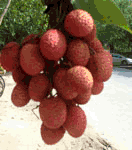
| Lychee berries in a bundle as displayed by a seller in India. |
Litchis dry off sooner if kept open at room temperature for a few hours; should often be moistened to keep them afresh. Fresh fruits can be stored at room temperature for up to 2-3 days and can be stored for up to five weeks in the refrigerator. They can also be frozen or dried and canned for the purpose of exporting.
Preparation and serving methods
Separate each fruit from the stalk and wash them in cold water. To peel, gently pinch at the stem end and peel away the outer coat slowly. Alternatively, using a small paring knife, make an incision lengthwise all the way to the tip of its tough outer skin. Take care not to squeeze the flesh, or else you may squirt and end up losing juice! Next, gently peel away the outer tough skin along with the thin inner membrane to expose beautiful, jelly-textured translucent white flesh inside.
Eat peeled berry just like you do table grapes. Do not bite. To enjoy, gently suck its divinely sweet juice by rolling it between your tongue and palate. Seeds are inedible. Just spit it out.
Here are some serving tips:
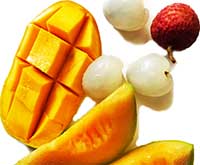 |
| Lychee fruits with other summer treats; mango and melon. |
Fresh lychee arils or flesh should be enjoyed all alone without any additions or seasonings.
Litchi slices can be a great addition to fruit salads and dressings.
Lychee juice can be a refreshing drink during the summer season.
Litchis can be used in jellies, jams, sorbets, sauces, and syrups.
Safety profile
Litchi fruit allergic reactions are quite rare to occur. Its seeded, sweet pulp can be safely given to children. People with diabetes may want to avoid eating too many of them because of their high sugar content. (Medical disclaimer)
Facts qoute
Research studies suggest that oligonol, a low molecular weight polyphenol, is found abundantly in the lychee fruit. Oligonol is thought to have antioxidant and anti-influenza virus actions. Besides, it helps improve blood flow to organs, reduce weight, and protect skin from harmful UV rays.
Also read ≻≻-
≻≻-Lanzone (langsat) fruit nutrition facts and health benefits.
≻≻-Rambutan nutrition facts and health benefits.
≻≻-Fruits from Lychee (Litchi). Visit here for an impressive list of all varieties of fruits with complete illustrations of their nutrition facts and health benefits.
≻≻-Back to Home page.
Further References:
USDA National Nutrient Database. (opens new window)
Litchi chinensis- PDF.
Stanford School of Medicine Cancer information Page- Nutrition to Reduce Cancer Risk (Link opens in new window).