Sage herb Nutrition facts
Sage herb or garden sage is one of the traditional herbs known since ancient Roman times. This sharp-flavored legendary plant has long been recognized as "the guardian of herbs." Apart from cooking, it is also found in various traditional European and Chinese medicines for its health-promoting and disease-preventing properties.
Herb sage is an evergreen perennial shrub commonly seen all over the Mediterranean and south-eastern Europe (Balkan) regions. Botanically, it belongs to the family of Lamiaceae, in the genus, Salvia.
Scientific name: Salvia officinalis.
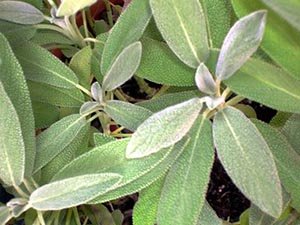 |
| Sage herb (Salvia officinalis). Note for narrow, pointed dark green leaves. Photo courtesy: thatredhead4 |
Sage flourishes well under sandy, alkaline soil supplemented with adequate sunlight conditions. It grows up to 75 cm in height and features woody, branching stems.
Its pebble-like patterned, aromatic leaves feature a grey-green, soft surface with fine hair-like filaments growing on either side. By summer, it produces violet-blue flowers in clusters that attract bees.
Several cultivars of sage grown, meant either for medicinal or culinary purposes.
Three-lobed, Greek sage (S. fruiticosa or S. triloba): Large perennial with lobed leaves, cultivated in the Mediterranean region and commonly employed in the preparation of sage tea.
Pineapple sage (S. rutilans): Fresh leaves add flavor to desserts and drinks.
Clary sage (S. sclarea): Strongly aromatic leaves generally used as throat gargle infusions and in perfumeries.
Azure sage (S. azurea): A large plant with blue flowers, used in Mexico as an herbal panacea.
8 impressive Health benefits of Sage herb
Sage herbal parts have many notable plant-derived chemical compounds, essential oils, minerals, and vitamins that are known to have disease-preventing, and health-promoting properties.
The main active components of common sage appear to be its essential oil, which chiefly contains ketones; alpha-thujone, and ß-thujone. Besides, it also contains numerous other compounds, including cineol, borneol, tannic acid; bitter substances like cornsole and cornsolic acid; fumaric, chlorogenic, caffeic and nicotinic acids; nicotinamide; flavones; flavone glycosides and estrogenic substances. Altogether, these compounds are known to have counter-irritant, rubefacient, anti-inflammatory, anti-allergic, anti-fungal, and antiseptic properties.
Thujone is GABA and Serotonin receptor (5-HT3) antagonist. It improves mental concentration, and attention span and quickens the senses; hence sage infusion has long been recognized as "thinker's tea."
Three lobe sage (S. triloba) composes flavone called salvigenin. Research studies found that the vascular relaxant effect of salvigenin may offer protection from cardiovascular diseases.
The herb is an exceptionally very rich source of several B-complex groups of vitamins, such as folic acid, thiamin, pyridoxine and riboflavin many times higher than the recommended daily levels.
The herb contains very good amounts of vitamin-A and beta-carotene levels. 100 g dry ground herb provides 5900 IU; about 196% of RDA. Vitamin A is a powerful natural antioxidant and is essential for night vision. It is also required for maintaining healthy mucosa and skin. Consumption of natural foods rich in vitamin A known to help the body protect from lung and oral cavity cancers.
Fresh sage leaves are a good source of antioxidant vitamin, vitamin-C; contain 32.4 or 54% of RDA. Vitamin C helps in the synthesis of structural proteins like collagen. It contributes to maintaining the integrity of blood vessels, skin, organs, and bones. Regular consumption of foods rich in vitamin C helps protect from scurvy, develop resistance against infectious agents (boosts immunity), and scavenge harmful, pro-inflammatory free radicals from the human body.
Sage herb parts, whether fresh or dried, are rich sources of minerals like potassium, zinc, calcium, iron, manganese, copper, and magnesium. Potassium is an important component of cell and body fluids, which helps control heart rate and blood pressure. The human body uses manganese as a co-factor for the antioxidant enzyme, superoxide dismutase.
| Principle | Nutrient Value | Percent of RDA |
|---|---|---|
| Energy | 315 Kcal | 15.75% |
| Carbohydrates | 60.73 g | 47% |
| Protein | 10.63 g | 19% |
| Total Fat | 12.75 g | 42.5% |
| Cholesterol | 0 mg | 0% |
| Dietary Fiber | 40.3 g | 106% |
| Vitamins | ||
| Folates | 274 µg | 63% |
| Niacin | 5.720 mg | 35.75% |
| Pyridoxine | 2.690 mg | 206% |
| Riboflavin | 0.336 mg | 26% |
| Thiamin | 0.754 mg | 68.5% |
| Vitamin A | 5900 mg | 196% |
| Vitamin C | 32.4 mg | 54% |
| Vitamin E | 7.48 mg | 50% |
| Vitamin K | 1714.5 µg | 1429% |
| Electrolytes | ||
| Sodium | 11 mg | <1% |
| Potassium | 1070 mg | 23% |
| Minerals | ||
| Calcium | 1652 mg | 165% |
| Copper | 0.757 mg | 84% |
| Iron | 28.12 mg | 351% |
| Magnesium | 428 mg | 107% |
| Manganese | 3.133 mg | 136% |
| Zinc | 4.70 mg | 43% |
| Phyto-nutrients | ||
| Carotene-α | 0 µg | -- |
| Carotene-ß | 3485 µg | -- |
| Crypto-xanthin-ß | 109 µg | -- |
| Lutein-zeaxanthin | 1895 µg | -- |
Selection and storage
Fresh leaves are sought after in cooking for their subtle aromatic flavor than that of the dried sage. If you have one in your home garden, the fresh leaves can be gathered as and when required.
In the markets, look for farm-fresh, culinary sage leaves that feature either plain narrow leafy, or non-flowering broad-leaf types as they are the preferred items in cooking.
Dried, as well as the ground (powder), the sage herb can also be available in herbal stores. Look for authentic sources from the organically grown sage. Fresh leaves to be used in marinades should be flavorful and devoid of blemishes, mold, and wilt.
Store fresh herbs in plastic bags placed inside the refrigerator. Dried sage should be kept in an air-tight container and put in a cool, dark, and dry place where it may stay fresh for several months.
Culinary uses
Sage leaves, in general, are harvested just before the flowering stage for culinary purposes. Discard tough stems and fibers before using them in recipes. Wash in cold water to remove soil and sand. Gently pat dry using a soft cloth.
Sage herb is one of the common ingredients in Greek, Italian, and Balkan cuisine.
Here are some serving tips:
Fresh leaves can be used in stuffing in-season sausages, poultry, and fish.
The herb is also used in many vegetable dishes, especially with beans.
It is also employed as a garnish in herb salads.
Roast pork and mushrooms with sage, marjoram and celery leaves.
Medicinal uses of sage
The essential oil obtained from the herb has been found to have acetylcholinesterase (Ach) enzyme inhibition actions resulting in increased availability of Ach levels in the brain. Ach enzyme improves concentration and may play a role in the treatment of memory loss associated with diseases like Alzheimer's.
Sage oil, distilled from the flowering tops, is composed of volatile essential oils such as camphene, cineol, borneol, bornyl acetate, and other esters. These compounds are known to have tonic, astringent, diaphoretic, and stimulant properties.
Sage herb oil is also being used externally as a rubefacient to soothe painful ailments like muscle stiffness, rheumatism, and neuralgic conditions.
Further, its oil is used as a blended massage oil and in aromatic therapy. It helps relieve nervousness, anxiety, headaches, stress, and fatigue. (Medical disclaimer).
Safety profile
Sage herb, when used in large amounts can cause nerve irritation, convulsions, and death. Hence its use is prohibited in known epileptic conditions.
The herb should not be used in pregnancy as chemical compounds like thujone in it may cause uterine stimulation resulting in abortion. (Medical disclaimer).
≺≺ Back to Herbs from Sage herb. Visit here for an impressive list of all varieties of Herbs with complete illustrations of their nutrition facts and health benefits.
≺≺ Back to Home page.
Further Resources:
Stanford School of Medicine Cancer information Page- Nutrition to Reduce Cancer Risk.
Antioxidative Phenolic Compounds from Salvia officinalis- PDF.