Peanut oil nutrition facts
Sweet, nutty, and flavorful peanut oil is an organic edible oil obtained from pressing peanut kernels. Peanuts are believed to be originating in the Central American region from where they spread to other parts of the world by Spanish explorers. Today, peanut crops are widely cultivated as important oilseeds at a commercial scale in China, India, African nations, and the United States of America.
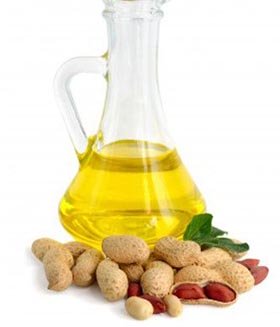 |
| Peanut oil. Courtesy: Indiamart |
Peanut plant is a low-growing, annual plant belonging to the family of Fabaceae (Leguminosae) of the genus: Arachis, and botanically named Arachis hypogaea. Some of the common names are groundnut, earthnut, goober, pinder, and ground pea. In addition to being pressed for oil, peanut kernels are eaten fresh or roasted and used in cooking and confectionery as well.
Physical characteristics of peanut oil
Cold-pressed peanut oil has a deep yellow color with a pleasant nutty aroma and sweet taste. Refined oil features a light-yellow and neutral taste. However, refining makes it virtually devoid of impurities and allergens. Its specific gravity @ 25 °C is 912-0.920, Iodine value-84–100, and saponification value-185–195.
Peanut oil Nutrition facts
Peanut oil is high in energy; 100 g oil provides 884 calories.
It is one of the cooking oils with a high smoke point; of 450 °F which allows for setting oil at higher temperatures while deep-frying food items.
Peanut oil composes a very good lipid profile. It has saturated, monounsaturated, and polyunsaturated (SFA: MUFA: PUFA= 18: 49: 33) fats in healthy proportions.
It is one of the stable cooking oils which has a long shelf life.
Health benefits of Peanut oil
Wonderfully pleasant, sweet-flavored peanut oil is low in saturated fats, free from cholesterol, and contains essential fatty acid ( linoleic acid (omega-6)) making it one of the healthiest cooking oils.
Being a vegetable oil, peanut oil is a good source of plant sterols, especially ß-sitosterol.
The FDA has approved the following claim for phytosterols: "Foods containing at least 0.4 gram per serving of plant sterols, eaten twice a day with meals for a daily total intake of at least 0.8 gram, as part of a diet low in saturated fat and cholesterol, may reduce the risk of heart disease. "Phyto-sterols competitively inhibit cholesterol absorption in the gut and thereby can reduce cholesterol levels by 10% to 15%.
Peanut oil is one of high-calorie foods. Its calorie value comes from fatty acids. Nonetheless, the oil is especially rich in monounsaturated fatty acids (MUFA) like oleic acid (18:1) that help lower LDL or "bad cholesterol" and increase HDL or "good cholesterol" in the blood. Research studies suggest that the Mediterranean diet that is enriched with monounsaturated fatty acids helps to prevent coronary artery disease and strokes by favoring a healthy blood lipid profile.
Peanut oil contains resveratrol, a polyphenol antioxidant, which has been found to have a protective function against cancers, heart disease, degenerative nerve disease, Alzheimer's disease, and viral/fungal infections.
Studies suggest that resveratrol cut stroke risk through altering molecular mechanisms in the blood vessels (reducing susceptibility to vascular damage through decreased activity of angiotensin, a systemic hormone causing blood vessel constriction that would elevate blood pressure) and by increasing production of the vasodilator hormone, nitric oxide.
Peanut oil contains valuable amounts of antioxidant vitamin-E. 100 g fresh oil has 15.69 mg of α-tocopherol and 15.91 mg of γ-tocopherol. Vitamin E is a powerful lipid-soluble antioxidant, required for maintaining the integrity of the cell membrane of mucosa and skin by protecting it from harmful oxygen-free radicals.
In addition to being a vegetable source, peanut oil is also an ideal choice for deep-frying where it can be heated to higher temperatures (smoke point -450 °F). This results in lower oil retention in fried foods.
| Principle | Nutrient Value | Percent of RDA |
|---|---|---|
| Energy | 884 Kcal | 44% |
| Carbohydrates | 0 g | 0% |
| Protein | 0 g | 0% |
| Total Fat | 100 g | 500% |
| Cholesterol | 0 mg | 0% |
| Dietary Fiber | 0 g | 0% |
| Vitamins | ||
| Folates | 0 µg | 0% |
| Niacin | 0 mg | 0% |
| Pantothenic acid | 0 mg | 0% |
| Pyridoxine | 0 mg | 0% |
| Riboflavin | 0 mg | 0% |
| Thiamin | 0 mg | 0% |
| Vitamin A | 0 IU | 0% |
| Vitamin C | 0 | 0% |
| Vitamin E | 15.7 mg | 105% |
| Vitamin K | 0.7 µg | 0.5% |
| Electrolytes | ||
| Sodium | 0 mg | 0% |
| Potassium | 0 mg | 0% |
| Minerals | ||
| Calcium | 0 mg | 0% |
| Copper | 0 mg | 0% |
| Iron | 0.03 mg | <0.5% |
| Magnesium | 0 mg | 0% |
| Manganese | 0 mg | 0% |
| Phosphorus | 0 mg | 0% |
| Selenium | 0 µg | 0% |
| Zinc | 0.01 mg | <1% |
| Phyto-nutrients | ||
| Carotene-ß | 0 µg | -- |
| Crypto-xanthin-ß | 0 µg | -- |
| Lutein-zeaxanthin | 0 µg | -- |
| Phytosterols | 207 mg | -- |
Selection and storage
Peanut oil is available in the markets year-round. In the stores, different forms (types) of oils are obtainable, which are labeled as; cold-pressed, roast-pressed, refined, double-refined, etc. Oftentimes, it may be blended with other cheap vegetable oils like cottonseed oil. Buy fresh peanut oil from authentic sources.
Pure peanut oil is amber-yellow and has a sweet, nutty flavor. Refined oil is very light in color and devoid of impurities and allergens. Avoid off-smelling, old stocks as the oil might have turned rancid.
The Shelf-life of peanut oil is about six months under ordinary conditions. When preserved in an airtight container in cool, dry, dark, and moisture-free environments, its quality may remain fine for up to nine months. Its shelf may be extended for more than 12 months with the addition of antioxidants like vitamin-E.
Culinary use
Peanut oil is another healthy source of edible cooking oil like soy or olive oils. It is widely used for cooking purposes for its aromatic flavor, especially in many Southeast and South Asian countries. It has a pleasant taste suitable for addition to dressing, frying, and sautéing. The oil is also used in the manufacture of kinds of margarine and salad dressing.
Safety profile
Peanut oil allergy is a type of hypersensitivity response in some people to food substances prepared using this oil.
Allergy reactions may include symptoms like vomiting, pain abdomen, swelling of lips and throat leading to breathing difficulty, chest congestion, and death. It is, therefore, advisable to avoid any food preparations that contain peanut products in these individuals.
Research, however, suggests that highly refined peanut oil, which has had all the allergic proteins and impurities removed, does not cause this hypersensitive response; even in severely allergic persons. (Medical Disclaimer).
≻≻-Read Peanuts.
≻≻-Back to Dietary oils and fats from Peanut oil.
≻≻-Back to Home page.
Further Resources: