Cherimoya fruit Nutrition facts
Sweet, pulpy, and fragrant rich cherimoya is one of the most delicious tropical fruits of Andean Valley origin. These greenish-yellow, conical fruits are obtained from the Annonaceae family of evergreen trees, in the genus of Annona.
It has been thought to be native to the Loja region of Ecuador, bordering Peru, the low-rising tropical forests of the Central Andean Mountains.
Scientific name: Annona cherimola.
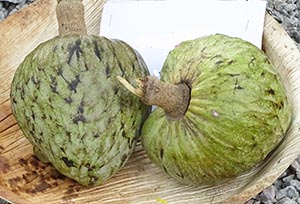 |
| Cherimoya fruit-Annona cherimola. |
Annona is a small-sized tree, grows to about 15 to 30 feet tall with dense foliage, and bears fruits after 4-5 years of plantation. In their natural habitat, cherimoya flowers are pollinated by insects (Coleoptera, Hemiptera). However, in the cultivated farms, artificial pollination is done at large to obtain good yields.
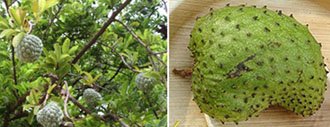 |
| Custard apple and Soursop (Guanabana). |
The fruit is irregularly oval or conical in shape featuring leathery dark-green skin with polygonal indentations. It measures about 10-15 cm in length and 10 cm in diameter and weighs about 350 g to 500 g. In some varieties, they weigh several pounds.
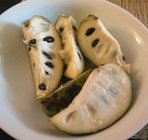
Ripe fruits turn pale green to light brown and emanate a sweet, fragrant aroma that can be appreciated from a distance. Inside the flesh is creamy with several smooth, shiny, black seeds embedded in it. Seeds and skin are inedible.
Custard apple (Annona reticulata) is another closely related fruit commonly grown in India, Pakistan, and other South Asian regions. It features smooth, conical indentations.
Sugar apple or atis fruit (A. squamosa) features smooth conical protuberances (carpels) over its surface. It has a similar taste and flavor as cherimoya; however, on its interior, it contains relatively less flesh but more seeds for its size.
Atemoya is hybrid of cherimoya (A. cherimola) and sugar apple (A. squamosa). It has better temperature and humidity tolerance, suitable for cultivation in tropical climates.
Guanabana (Annona muricata), also known as soursop (graviola), is much larger than cherimoya. It is easily distinguished by its size, spiky surface, and fibrous, tart flesh.
Health benefits of Cherimoya
Pleasantly sweet and flavorful cherimoya contains an impressive list of essential nutrients, vitamins, antioxidants, and minerals.
The fruit has calories equivalent to that of mangoes. 100 g of fresh fruit pulp provides about 75 calories. It, however, contains no saturated fats or cholesterol. Its flesh is a good source of soluble dietary fiber (3 g% or 8% of RDA), which helps decrease the absorption of cholesterol in the gut. The fiber also helps protect the colon mucosa from exposure to toxic substances by binding cancer-causing chemicals to it.
Cherimoya contains several polyphenolic antioxidants. Among them, the most prominent in Annona family fruits are Annonaceous acetogenins. Acetogenin compounds such as asimicin, bullatacinare, etc., are powerful cytotoxins and have been found to have anti-cancer, anti-malarial, and anti-helminth properties.
It is very good in vitamin-C. Vitamin C is a powerful natural antioxidant. Soursop (A.muricata) relatively has more vitamin C (34% of RDA).
Consumption of fruits rich in vitamin C helps the human body develop resistance against infectious agents and scavenge harmful, pro-inflammatory free radicals from the body.
Also, cherimoya fruit is a good source of B-complex vitamins, especially vitamin B-6 (pyridoxine). 100 g fresh fruit provides 0.257 mg or 20% of daily recommended levels. Pyridoxine helps keep up GABA neurochemical levels in the brain. High GABA levels calm down nervous irritability, tension, and headache ailments.
Further, it has a well-balanced sodium-potassium ratio. A good potassium level in the body helps control heart rate and blood pressure, and thus, counters the bad influences of sodium. It also contains more minerals weight per weight than many common fruits like apples, being rich in copper, magnesium, iron, and manganese.
| Principle | Nutrient Value | Percent of RDA |
|---|---|---|
| Energy | 75 Kcal | 4% |
| Carbohydrates | 17.71 g | 13.5% |
| Protein | 1.57 g | 3% |
| Total Fat | 0.68 g | 3% |
| Cholesterol | 0 mg | 0% |
| Dietary Fiber | 3 g | 8% |
| Vitamins | ||
| Folates | 23 µg | 6% |
| Niacin | 0.644 mg | 4% |
| Pantothenic acid | 0.345 mg | 7% |
| Pyridoxine | 0.257 mg | 20% |
| Riboflavin | 0.131 mg | 10% |
| Thiamin | 0.101 mg | 8% |
| Vitamin A | 5 IU | <1% |
| Vitamin C | 12.6 mg | 21% |
| Vitamin E | 0.27 mg | 2% |
| Electrolytes | ||
| Sodium | 7 mg | 0.5% |
| Potassium | 287 mg | 6% |
| Minerals | ||
| Calcium | 10 mg | 1% |
| Copper | 0.069 mg | 8% |
| Iron | 0.27 mg | 3% |
| Magnesium | 17 mg | 4% |
| Manganese | 0.093 mg | 4% |
| Phosphorus | 26 mg | 4% |
| Zinc | 0.16 mg | 1% |
| Phyto-nutrients | ||
| Carotene-ß | 2 µg | -- |
| Cryptoxanthin-ß | 1 µg | -- |
| Lutein-zeaxanthin | 6 µg | -- |
Selection and Storage
|
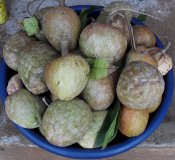
| Cherimoya in a market. |
At its natural habitat, the cherimoya season lasts from November until May. Usually, the fruit is handpicked by clipping upon reaching maturity. In the markets, buy fresh, firm, medium-sized, uniform fruits featuring greenish-yellow color and full for their size. Ripe fruits just yield to gentle pressure.
Avoid those with broken skin, surface blemishes, and overly-ripen ones as they stay poorly.
Once at home, keep mature fruits in a fruit basket at room temperature until they ripen. Cherimoya has a very short shelf life. Once ripens, it quickly deteriorates at room temperature. As in bananas, the whole cherimoya cannot either be stored inside the refrigerator for an extended period as they sustain chilling injury. However, juiced or pureed, the fruit may be kept in the freezer for several weeks.
Preparation and Serving tips
Cherimoya has a unique fragrant flavor and delicious taste. To prepare, wash the fruit in cold running water. Gently mop dry using a paper towel. Cut the fruit lengthwise and eat it by scooping it with a spoon. Discard seeds and peel.
Here are some serving tips:
|
| Cherimoya fruit slices. Photo courtesy: bobman |
The fruit is better eaten out of hand on its own, without any add-ons or seasonings.
Pulp pureed and mixed with other fruits in salads or can be used for ice-cream toppings.
Cherimoya juice is a refreshing drink.
Tart flavored guanabana or soursop can be mixed with honey, sugar, milk, and ice; and served chilled as sorbet or with other fruit cocktails and milkshakes.
United States Department of Agriculture- National Nutrient Data base.
Stanford School of Medicine Cancer information Page- Nutrition to Reduce Cancer Risk.
Also read ≻≻-
≻≻- Custard apple nutrition facts.
≻≻- Back to Fruits from Cherimoya. Visit here for an impressive list of all varieties of fruits with complete illustrations of their nutrition facts and health benefits.
≻≻- Back to Home page.
Further resources: