Cauliflower Nutrition facts
Cauliflower (cabbage flower) is one of the familiar winter season vegetables. These beautiful flower heads are brimming with essential nutrients, and hold numerous health-benefiting phytonutrients such as vitamins, indole-3-carbinol, and sulforaphane that help prevent overweight, and diabetes and offer protection from prostate, ovarian, and cervical cancers.
Botanically, it is a member of the cruciferous or Brassicaceae family of vegetables and has a similar nutritional and phytochemistry profile as that of other brassica family veggies like broccoli and cabbage.
|
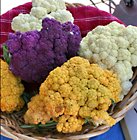 |
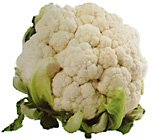
| Cauliflower head. | Colorful cauliflowers in a market. Photo courtesy: La Grande |
As in broccoli, cauliflower is also made up of tightly clustered florets that begin to evolve but halt at an immature (bud) stage. This cool-season vegetable prefers moisture-rich, fertile soil to flourish.
Other than the common snow-white variety, several cultivars exist including green, orange, purple, and romanesco heads.
Health benefits of Cauliflower
It is very low in calories. 100 grams of the fresh cauliflower head provides just 26 calories. Also, it is one of the flower vegetables that is low in fat and cholesterol. Nevertheless, it comprises several health-benefiting antioxidants and vitamins.
Its florets contain about 2 grams of dietary fiber per 100 g, providing about 5% of the recommended value.
Cauliflower contains several anti-cancer phytochemicals like sulforaphane and plant sterols such as indole-3-carbinol, which appears to function as an anti-estrogen agent. Together, these compounds have proven benefits against prostate, breast, cervical, colon, and ovarian cancers by virtue of their cancer-cell growth inhibition, and cytotoxic effects on cancer cells.
Furthermore, Di-indolyl-methane (DIM), a lipid-soluble compound present abundantly in the Brassica group of vegetables, has been found to be effective as an immune modulator, antibacterial and anti-viral agent. This compound brings out these functions by its ability to synthesize and potentiate γ-Interferon receptors at the cellular level. DIM has currently been found application in the treatment of recurring respiratory papillomatosis caused by the Human Papilloma Virus (HPV) and is in Phase III clinical trials for cervical dysplasia.
Fresh cauliflower is an excellent source of vitamin-C; 100 g provides about 48.2 mg or 80% of the daily recommended value. Vitamin C is a proven antioxidant that helps fight against harmful free radicals, boosts immunity, and prevents infections and cancers.
It contains good amounts of many vital B-complex groups of vitamins such as folates, pantothenic acid (vitamin B5), pyridoxine (vitamin B6), and thiamin (vitamin B1), niacin (B3) as well as vitamin K. These vitamins are essential in the sense that the body requires them from external sources to replenish and required for fat, protein, and carbohydrate metabolism.
Further, It is also a good source of minerals in small quantities such as manganese, copper, iron, calcium, and potassium. Manganese is used in the body as a co-factor for the antioxidant enzyme, superoxide dismutase. Potassium is an important intracellular electrolyte that helps counter the hypertension effects of sodium.
| Principle | Nutrient Value | Percent of RDA |
|---|---|---|
| Energy | 25 Kcal | 1% |
| Carbohydrates | 4.97 g | 4% |
| Protein | 1.92 g | 4% |
| Total Fat | 0.28 g | 1% |
| Cholesterol | 0 mg | 0% |
| Dietary Fiber | 2.0 g | 5% |
| Vitamins | ||
| Folates | 57 µg | 14% |
| Niacin | 0.507 mg | 3% |
| Pantothenic acid | 0.667 mg | 13% |
| Pyridoxine | 0.184 mg | 14% |
| Riboflavin | 0.060 mg | 4.5% |
| Thiamin | 0.050 mg | 4% |
| Vitamin A | 0 IU | 0% |
| Vitamin C | 48.2 mg | 80% |
| Vitamin E | 0.08 mg | 0.5% |
| Vitamin K | 15.5 µg | 13% |
| Electrolytes | ||
| Sodium | 30 mg | 2% |
| Potassium | 299 mg | 6% |
| Minerals | ||
| Calcium | 22 mg | 2% |
| Copper | 0.039 mg | 4.5% |
| Iron | 0.42 mg | 5% |
| Magnesium | 15 mg | 3.5% |
| Manganese | 0.155 mg | 7% |
| Zinc | 0.27 mg | 2.5% |
| Phyto-nutrients | ||
| Carotene-ß | 0 µg | -- |
| Lutein-zeaxanthin | 1 µg | -- |
Selection and storage
Cauliflowers can be available year-round in the markets; however, they are at their best during the winter months. In general, time the harvest when the flower head reaches the desired size but before its florets begin to separate.
In the stores, choose fresh heads featuring snow/cream-white, compact, medium-sized heads that feel heavy in the hands. Grainy surfaces and gaps between florets indicate signs of overmaturity, while greenish coloration may be due to overexposure to sunlight. Avoid heads with bruised surfaces as they indicate poor handling of the flower and also those with dark color patches as they indicate mold disease known as "downy mildew."
Once at home, store in the refrigerator set at higher relative humidity. They stay fresh for about a week if kept properly.
Preparation and serving methods
Its creamy-white flower heads are favorite items sought after by chefs worldwide. To wash, place the head upside down, and rinse in a large bowl of cold water or saltwater brine for about 15-20 minutes to ensure the removal of any insects, soil, or fungicide/insecticide sprays. Gently pat dry using a soft cloth. Remove tough stems and leaves.
Usually, the florets are cut into equal sections/cubes to help cook evenly. Cook covered in boiling water, with some added common salt till they become tender for a few minutes. Overcooking may result in loss of nutrients, especially vitamin C.
Here are some serving tips:
Cauliflower mixes well with other complementing vegetables and lentils.
Aloo-gobi (potato-cauliflower) is a very popular dish in South Asian countries, especially in India, Pakistan, and Nepal. Gobi-manchurian is another Indian-Chinese snack in which stir-fried florets are mixed with Chinese-style sauces in a mouthwatering recipe.
Its florets are added in a pasta bake, casseroles and to make curry/soup.
It is also widely used in pickling.
Safety profile
Like other members of the brassica/cruciferous family, prolonged/excessive use of cauliflower may cause swelling of the thyroid gland and thyroid hormone deficiency. This condition is due to the presence of certain plant compounds known as goitrogens in these groups of vegetables. Therefore, it is advised to avoid it; especially in individuals with thyroid dysfunction. However, they may be used liberally in a healthy person. (Medical disclaimer).
≻≻-Back to Vegetables from Cauliflower nutrition. Visit here for an impressive list of vegetables with complete illustrations of their nutrition facts and health benefits.
≻≻-Back to Home page.
Further Resources:
Stanford School of Medicine Cancer information Page- Nutrition to Reduce Cancer Risk.