logo for nutrition-and-you.com
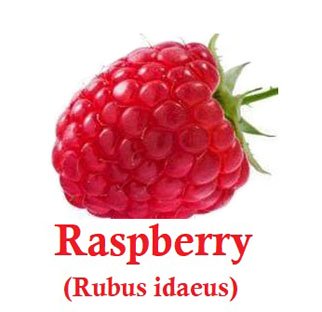
leftimage for nutrition-and-you.com raspberry
Custom Search

Raspberry nutrition facts

Wonderfully delicious and rich red colored raspberry among the most popular berries grown all over the world. They are rich source of many health promoting plant-derived nutrients, minerals, and vitamins that are essential for optimum health.

Botanically, the plant is a small shrub belonging to the family Rosaceae, of the genus: Rubus. It grows very well in temperate regions. The exotic berry is native to Europe but now widely cultivated in many temperate regions all over the world. Main producers of raspberries are Poland, United States, Germany, and Chile.

Botanical name: Rubus idaeus.


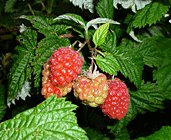
raspberries rubus idaeus- raspberry plant
Delicious raspberries! Rubus idaeus plant.
Photo courtesy: mat_the_w


Several subspecies of raspberries are grown but the most important modern commercial red raspberry cultivars derive from hybrids between R. idaeus (European raspberry) and R. strigosus (American raspberry). Raspberries have a taste that varies by cultivar, and ranges from quite sweet to acidic, a feature quite similar to strawberries.

Technically, the whole berry is an aggregate of small drupe-lets, which are arranged in circular fashion around a hollow central cavity. Each small drupelet features small juicy pulp with single tiny whitish-yellow seed.

Raspberry has conical shape, weighs about 3-4 g and contains 80-100 drupelets arranged in circular layers. While the most common type of raspberry (Rubus idaeus) is red-pink in color, hybrids actually comes in a range of colors including black, purple, orange, yellow and white.


Health benefits of raspberries

  • Delicious raspberries are low in calories and saturated fats but are rich source of dietary fiber and anti-oxidants.100 g berries provide just 52 calories but contain 6.5 g of fiber.

  • Raspberries have significantly high levels of phenolic flavonoid phytochemicals such as anthocyanins, ellagic acid (a tannin), quercetin, gallic acid, cyanidins, pelargonidins, catechins, kaempferol and salicylic acid. Scientific studies show that these antioxidant compounds in these berries have potential health benefits against cancer, aging, inflammation, and neuro-degenerative diseases.

  • Xylitol, a low-calorie sugar substitute extracted from raspberries. Xylitol contains just 9.6 calories, as compared to one teaspoon of sugar, which has 15 calories. Xylitol absorbs more slowly than sugar and does not contribute to high blood sugar levels; can be helpful in diabetics.

  • Fresh raspberries are excellent source of vitamin-C, which is also a powerful natural anti-oxidant. 100 g berries provide 26.2 mg of vitamin C. Consumption of fruits rich in vitamin C helps body develop resistance against infectious agents, counter inflammation, and scavenge harmful free radicals.

  • Raspberry contains anti-oxidant vitamins like vitamin A, and vitamin E. In addition to the above mentioned antioxidants, is also rich in many other health promoting flavonoid poly phenolic antioxidants such as lutein, zeaxanthin,and beta carotene in small amounts. Altogether, these compounds help act as protective scavengers against oxygen-derived free radicals and reactive oxygen species (ROS) that play a role in aging and various disease process.

  • Raspberry has an ORAC value (oxygen radical absorbance capacity) of about 4900 per 100 grams, crediting it among the top-ranked ORAC fruits.

  • Raspberries contain good amount of minerals like potassium, manganese, copper, iron and magnesium. Potassium is an important component of cell and body fluids that helps controlling heart rate and blood pressure. Manganese is used by the body as a co-factor for the antioxidant enzyme superoxide dismutase. Copper is required in the production of red blood cells.

  • They are rich in B-complex group of vitamins and vitamin K. Contain very good amounts of vitamin B-6, niacin, riboflavin, and folic acid. These vitamins are function as co-factors and help body in the metabolism of carbohydrates, protein and fats.


See the table below for in depth analysis of nutrients:

Raspberry (Rubus idaeus), ORAC Value 4900/100 g,
Nutritive Value per 100 g,
(Source: USDA National Nutrient data base)
Principle Nutrient Value Percentage of RDA
Energy 52 Kcal 2.5%
Carbohydrates 11.94 g 9%
Protein 1.20 g 2%
Total Fat 0.65 g 3%
Cholesterol 0 mg 0%
Dietary Fiber 6.5 g 16%
Vitamins
Folates 21 mcg 5%
Niacin 0.598 mg 4%
Pyridoxine 0.055 mg 4%
Riboflavin 0.038 mg 3%
Vitamin A 33 IU 1%
Vitamin C 26.2 mg 47%
Vitamin E 1.42 mg 9%
Vitamin K 7.8 µg 6.5%
Electrolytes
Sodium 1 mg 0%
Potassium 151 mg 3%
Minerals
Calcium 25 mg 2.5%
Copper 90 µg 10%
Iron 0.69 mg 8.5%
Magnesium 22 mg 5.5%
Manganese 0.670 mg 29%
Zinc 0.42 mg 4%
Phyto-nutrients
Carotene-ß 12 µg --
Carotene-α 16 µg --
Lutein-zeaxanthin 136 µg --

Selection and storage

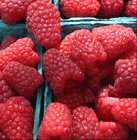
red raspberries
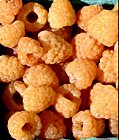
golden-raspberries
Delicious red raspberries!
Photo courtesy: La grande farmers market
Golden raspberries
Photo courtesy: La grande farmers market

Raspberries generally available year round in the stores, however, they are fresh and plentiful from June till October. In general, the berries are ready to be harvested when they comes off the receptacle easily and have turned to deep color (red, black, purple, or golden yellow, depending on the species and cultivar). At the stage when they are supposed to be the most ripen and sweetest.

In the store, select berries that feature shiny, deep red in color with attached green caps at the top end, firm, plump, free of sand and mold. Avoid those that appear dull, sunken or flattened and with mold, bruise or discolored patches.

Raspberries are easily perishable fruits; they should only be purchased a few days prior to use. Just before storing in the refrigerator, sort out damaged or bruised berries so that they should not spoil others. Place them in a wide bowl or spread them out on a plate covered with a paper towel, then cover with plastic wrap.

Raspberries will keep fresh in the refrigerator for one or two days. Use them as early as possible unless otherwise they are frozen and stored in the freezer compartment.


Preparation and serving methods

To wash Raspberries, dip them in cold water in a large bowl for few seconds and swish gently few times to remove any sand and insecticide residues. Gently pat them dry using paper towel or cloth. This method will also help bring them to normal room temperature, and so also increases their flavor and enrich taste. Then remove the stems and caps, if any, by simply pinching off with fingers or using a paring knife.

Here are some serving tips:

raspberry muffins
Delicious raspberry muffins!
Photo courtesy: leszekleszczynski
  • Fresh raspberry sections are a great addition to fruit or green salad.
  • They can be a great snack between meals.
  • Raspberry has also been used in fruit enriched pastries as in popular danish pastry.
  • Raspberries are a popular addition to dairy products, as in strawberry flavored ice creams, milkshakes, smoothies, and yogurt.


Safety profile

Raspberry may cause serious allergic reactions in some sensitized individuals. Some of the most common symptoms include swelling and redness of mouth, lips and tongue, eczema, hives, skin rash, headache, runny nose, itchy eyes, wheezing, gastrointestinal disturbances, depression, hyperactivity and insomnia. Individuals who suspect allergy to these fruits may want to avoid. (Medical disclaimer)


<<-Back to Fruit nutrition from Raspberry.  Visit here for an impressive list of all variety of fruits with complete illustrations of their nutrition facts and health benefits.

<<-Back to Home page.
Click this link to visit very informative pages on:-


Custom Search


      Bookmark and Share                                                                                              ^ Back to TOP

raspberry

                                                      © copyright 2009-11, www.nutrition-and-you.com.   All rights reserved
                                     Home | About us | Contact | Blog | Fruits | Vegetables | Nuts | Herbs | Spices | Articles |Privacy policy | Disclaimer

bottom image for nutrition-and-you.com