Cashew nut Nutrition facts
Delicately sweet yet crunchy and delicious cashew nut packed with energy, antioxidants, minerals, and vitamins that are essential for robust health. Cashew, or “caju” in Portuguese, is one of the popular ingredients in sweet as well savory dishes worldwide.
Botanically, cashew is an average-sized tropical evergreen tree belonging to the Anacardiaceae family, of the genus: Anacardium.
Scientific name: Anacardium occidentale.
 |
The cashew tree is native to Brazil’s Amazon rainforest. Portuguese explorers spread it across the continents, and today, it is cultivated on a commercial scale in Brazil, Vietnam, India, and many African countries.
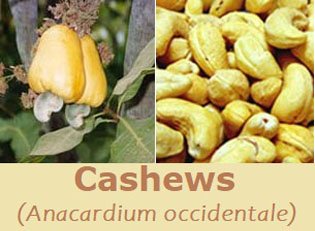
In a season, a cashew tree produces many, edible, pear-shaped false fruits or “accessory fruits” called "cashew apples." Cashew nut, which is botanically a “true fruit,” is attached at the bottom of this cashew-apple, giving it a clapper in the bell appearance. This tiny, bean-shaped, gray “true fruit” is actually a drupe, featuring a hard outer shell enclosing a single edible kernel known commercially as “cashew nut.”
Cashew shell composes toxic phenolic resin, urushiol, a potent caustic skin irritant toxin, and therefore, should be removed before you safely eat delicious cashew kernel.
In the processing units, this whole cashew is treated under a high flame to destroy urushiol toxin. Thus, roasted cashews become safe to handle with bare hands by workers who then mechanically shell the nuts to extract edible cashew kernels we find in the groceries.
Cashew measures about an inch in length, 1/2 inches across, and features a kidney or "bean shape" with a curved pointed tip and a smooth surface, and It splits into halves as in legumes. The cream-white kernel features a firm yet crunchy and buttery texture and sweet taste.
Health benefits of Cashew nuts
Cashews are high in calories. 100 g of nuts provide 553 calories. They are packed with soluble dietary fiber, vitamins, minerals, and numerous health-promoting phytochemicals that help protect from diseases and cancers.
They are rich in “heart-friendly” monounsaturated fatty acids like oleic, and palmitoleic acids. These essential fatty acids help lower harmful LDL cholesterol while increasing good HDL cholesterol in the blood.
Research studies suggest that the Mediterranean diet which is rich in monounsaturated fatty acids contributes to preventing coronary artery disease and strokes by favoring a healthy blood lipid profile.
Cashew nuts are abundant sources of essential minerals. Manganese, potassium, copper, iron, magnesium, zinc, and selenium are especially concentrated in them. A handful of cashew nuts a day in the diet would provide enough of these minerals and may help prevent deficiency diseases. Selenium is an important micronutrient, which functions as a co-factor for antioxidant enzymes such as Glutathione peroxidases, one of the most powerful antioxidants in the body.
Copper is a cofactor for many vital enzymes, including cytochrome c-oxidase and superoxide dismutase (other minerals function as co-factors for this enzyme are manganese and zinc). Zinc is a co-factor for many enzymes that regulate growth and development, gonadal function, digestion, and DNA (nucleic acid) synthesis.
Cashews are also good in many essential vitamins such as pantothenic acid (vitamin B5), pyridoxine (vitamin B-6), riboflavin, and thiamin (vitamin B-1). 100 g nuts provide 0.147 mg or 32% of the daily recommended levels of pyridoxine. Pyridoxine reduces the risk of homocystinuria and sideroblastic anemia. Niacin helps prevent "pellagra" or dermatitis.
Additionally, these vitamins are essential for the metabolism of protein, fat, and carbohydrates at the cellular level.
Further, they also hold a small amount of zeaxanthin, an important pigment flavonoid antioxidant, which is selectively absorbed into the retinal macula lutea in the eyes. It is thought to provide antioxidant and protective UV ray filtering functions and helps prevent age-related macular degeneration (ARMD) in older adults.
| Principle | Nutrient Value | Percent of RDA |
|---|---|---|
| Energy | 553 Kcal | 28% |
| Carbohydrates | 30.19 g | 23% |
| Protein | 18.22 g | 32.5% |
| Total Fat | 43.85 g | 146% |
| Cholesterol | 0 mg | 0% |
| Dietary Fiber | 3.3 g | 8.5% |
| Vitamins | ||
| Folates | 25 µg | 6% |
| Niacin | 1.062 mg | 6.5% |
| Pantothenic acid | 0.864 mg | 17% |
| Pyridoxine | 0.417 mg | 32% |
| Riboflavin | 0.058 mg | 4.5% |
| Thiamin | 0.423 mg | 35% |
| Vitamin-A | 0 IU | 0% |
| Vitamin-C | 0.5 mg | 1% |
| Vitamin-E | 5.31 mg | 35% |
| Vitamin-K | 34.1 µg | 28% |
| Electrolytes | ||
| Sodium | 12 mg | 1% |
| Potassium | 660 mg | 14% |
| Minerals | ||
| Calcium | 37 mg | 4% |
| Copper | 2.195 mg | 244% |
| Iron | 6.68 mg | 83.5% |
| Magnesium | 292 mg | 73% |
| Manganese | 1.655 mg | 72% |
| Phosphorus | 593 mg | 85% |
| Selenium | 19.9 µg | 36% |
| Zinc | 5.78 mg | 52.5% |
| Phyto-nutrients | ||
| Carotene-ß | 0 µg | -- |
| Crypto-xanthin-ß | 0 µg | -- |
| Lutein-zeaxanthin | 22 µg | -- |
Selection and storage
Cashew nuts are available in the market year-round. In the stores, only urushiol treated and shelled cashew kernels.
In the stores, one can find raw, salted, sweetened, or candied cashews. Buy shelled nuts that feature a bright cream-white, compact, uniform, and feel heavy in hand. They should be free from cracks, mold, and spots and free of rancid smell.
At home, store cashew kernels inside an airtight container, and keep them in the refrigerator to avoid them turning rancid. Fresh nuts should keep well for 5-6 months if stored so.
Culinary uses
Cashews have a crunchy, buttery texture with a pleasantly sweet, fruity aroma.
Here are some serving tips:
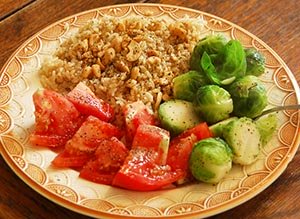 |
| Cashew fried rice with brussel sprouts and tomato (Photo: by waldopics) |
Cashews can be enjoyed as a snack as they are. They can also be eaten salted or sweetened.
Cashews are nutty yet pleasantly sweet in taste. They can be relished as a garnish in various kinds of sweets and desserts.
Cashews, along with almonds and other dry fruits, are being used in savory rice dishes Hyderbad-biriyani, rice-pulao...etc, and in curry (kaaju-shahi-paneer) preparations in Indian, Persian, Pakistani, and Middle-Eastern regions.
Split or crushed cashew along with almonds, pistachio is often sprinkled over desserts, particularly sundaes, and other confectionaries to enhance flavor.
The nuts are widely employed in the confectionery, as an addition to biscuits, sweets, and cakes.
Cashew apples are among popular fruits; eaten on their own in many regions around the world. They are also being used to prepare healthy drinks.
Safety profile
Cashew nut allergy is a common hypersensitivity condition in some individuals, especially in children. The reaction symptoms may range from simple skin itching (hives) to severe forms of anaphylactic manifestations, including breathing difficulty, pain abdomen, vomiting, and diarrhea.
The allergic manifestations are due to the chemical compound anacardic acid (urushiol) that is present in cashew apples, shells, and nuts. Cross-reactions may also occur with some other nuts and fruits of the Anacardiaceae family such as mango, pistachio, etc.
Individuals with known allergic reactions to cashew nuts and fruit may observe caution while eating them. (Medical disclaimer).
≻≻-Back to Nuts and Seeds from Cashew nut. Visit here for an impressive list of nuts with complete illustrations of their nutrition facts and health benefits.
≻≻-Back to Home page.
Further Resources:
Stanford School of Medicine Cancer information Page-Nutrition to Reduce Cancer Risk.
EDIS-University of Florida-PDF.