Artichoke (Globe or French) Nutrition facts
Artichoke is one of the favorite winter season edible flower buds. Known as "Ankinara" in Greek, its use as a vegetable is well known to the ancient Greeks and Romans who advocated it for its medicinal and health-benefiting qualities. Botanically, it belongs to the thistle family (Asteraceae), in the genus: Cynara. Scientific name: Cynara cardunculus var. scolymus.
Globe artichoke grows up to 1.5-2 m tall, with arching, deeply lobed, silvery-green leaves about 0.5 m long. If left alone, beautiful light pink or purple flowers develop forming a large head from the edible buds. The bud is composed of compactly arranged triangular scales in a whorl fashion around a central "choke."
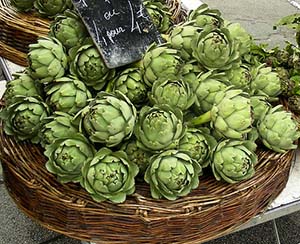 |
| Artichoke. Photo courtesy: Camilla K) |
Globe artichoke grows up to 1.5-2 m tall, with about 0.5 m long, arching, deeply lobed, silvery-green leaves. Its flower bud, known as the "globe," is composed of tightly packed triangular scales arranged in a whorl pattern around the central "choke." If left alone, a beautiful light pink to purple flower appears out of this globe (flower bud).
Each artichoke globe measures about 6-10 cm in diameter and weighs about 150 g. Fuzzy, immature florets at the center of the bud constitute its "choke." These are inedible in older, and larger flowers. The edible portion of the buds consists primarily of fleshy lower portions of the involucre bracts (triangular scales) and the base, known as the "heart."
Cardoons (Cynara cardunculus) are intimately related species to artichokes. However, unlike in artichokes, where their flower buds were sought after part of the plant, the blanched leafy stalks are the edible portions in cardoons.
Several cultivars of artichoke are grown and categorized based on their size, color, and spine.
Green color- big size,
Green color- medium size,
purple color- big size,
Purple color- medium size,
Spine variety.
Health benefits of Artichoke
Globe artichoke is low in calories and fat; 100 g of this flower bud just carries 47 calories. Nonetheless, it is one of the finest sources of dietary fiber and antioxidants. It provides 5.4 g per 100 g, about 14% of RDA fiber. Dietary fiber helps control constipation conditions, decreases bad or "LDL" cholesterol levels by binding to it in the intestines, and helps cut down colon cancer risks by preventing toxic compounds in the food from absorption.
Artichoke contains bitter principles, cynarin, and sesquiterpene-lactones. Scientific studies show that these compounds not only inhibit cholesterol synthesis but also increase its excretion in the bile, and thus, help overall reduction in the total cholesterol levels in the blood.
Fresh artichoke is an excellent source of folic acid. It provides about 68 µg per 100 g (17% of the recommended daily allowance). Folic acid works as a co-factor for enzymes involved in DNA synthesis. Scientific studies have shown that adequate levels of folates in the diet around the pre-conception period and in early pregnancy may help prevent neural tube defects in newborns.
Fresh globes contain moderate amounts of vitamin-C (provides about 20% of recommended levels per 100 g). Vitamin C is a powerful water-soluble antioxidant. Regular consumption of foods rich in vitamin C helps in scavenging harmful, pro-inflammatory free radicals from the body, and thereby protects our health against infectious agents.
It is one of the good vegetable sources for vitamin-K; provides about 12% of DRI. Vitamin K plays a vital role in bone health by promoting osteotropic (bone formation) activity. Adequate vitamin K levels in the diet help limit neuronal damage in the brain. It thus has a valuable role in the treatment of patients who have Alzheimer's disease.
It is also a good source of antioxidant compounds such as silymarin, caffeic acid, and ferulic acid, which help the body protect from harmful free-radical agents. Total measurable antioxidant strength (ORAC) of artichokes (globe or french) is 6552 µmol TE/100 g.
It is also rich in the B-complex group of vitamins such as niacin, vitamin B-6 (pyridoxine), thiamin, and pantothenic acid which are essential for optimum cellular metabolic functions.
Further, the artichoke is a rich source of minerals like copper, calcium, potassium, iron, manganese, and phosphorus. Potassium is an important component of cell and body fluids that helps control heart rate and blood pressure by countering the effects of sodium. Manganese is utilized by the human body as a co-factor for the antioxidant enzyme, superoxide dismutase. Copper is required in the production of red blood cells. Iron helps in the red blood cell synthesis in the bone marrow.
Additionally, it contains small amounts of antioxidant flavonoid compounds like carotene-beta, lutein, and zeaxanthin.
| Principle | Nutrient Value | Percent of RDA |
|---|---|---|
| Energy | 47 Kcal | 2% |
| Carbohydrates | 10.51 g | 8% |
| Protein | 3.27 g | 6% |
| Total Fat | 0.15 g | 0.5% |
| Cholesterol | 0 mg | 0% |
| DietaryFiber | 5.4 g | 14% |
| Vitamins | ||
| Folates | 68 µg | 17% |
| Niacin | 1.046 mg | 6.5% |
| Pantothenic acid | 0.338 mg | 7% |
| Pyridoxine | 0.116 mg | 9% |
| Riboflavin | 0.066 mg | 5% |
| Thiamin | 0.072 mg | 6% |
| Vitamin C | 11.7 mg | 20% |
| Vitamin A | 13 IU | 0.5% |
| Vitamin E | 0.19 mg | 1% |
| Vitamin K | 14.8 µg | 12% |
| Electrolytes | ||
| Sodium | 94 mg | 6% |
| Potassium | 370 mg | 8% |
| Minerals | ||
| Calcium | 44 mg | 4% |
| Copper | 0.231 mg | 27% |
| Iron | 1.28 mg | 16% |
| Magnesium | 60 mg | 15% |
| Manganese | 0.256 mg | 11% |
| Phosphorus | 90 mg | 13% |
| Selenium | 0.2 µg | <0.5% |
| Zinc | 0.49 mg | 4.5% |
| Phyto-nutrients | ||
| Carotene-α | 8 µg | |
| Crypto-xanthin | 0 µg | |
| Lutein-zeaxanthin | 464 µg |
Selection and storage
Harvest when the buds are still immature and pick just before their petals begin to open. Fresh globes can be readily available in the market all around the season, although they are at their best in the spring.
In the markets, choose fresh artichokes that feel heavy for their size and without any cuts or bruises. Its leaves should be compact (appose tightly together), should feature dark green, and squeak when squeezed. Avoid large, overmature globes as they are unappetizing.
The globes are best used while they are fresh. However, they can be kept well if stored in the refrigerator in a sealed plastic bag for up to a week.
Preparation and serving methods
Artichokes are a popular winter vegetable across Europe. Eat small or baby artichokes completely without removing a spiny choke lying inside.
To prepare bigger globes, rinse them in cold water. Trim away the stem leaving about an inch from the base. Remove the lower layer scales as they do not contain much flesh. Using a pair of scissors, trim away thorny scale ends. Trim its top end using a paring knife up to an inch. Spread out the scales with fingertips and then scrape off its central choke. Rub a lemon slice over a cut portion to prevent it from turning brown (discoloration). Then, boil the globe in the water upside down with some added salt and lemon juice until it gets soft.
To eat artichokes, take off one leaf at a time, dip in your favorite sauce, and scrape off the fleshy base with your teeth. The center and basal portions of the scale, close to its attachment to the heart hold a lot of edible flesh.
Don't forget to offer a side plate to pile discarded leaves and a soft towel/finger bowl to wash hands for the guests!
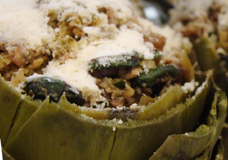 |
| Stuffed artichoke. (Photo courtesy: norwichnuts) |
Here are some serving tips:
Enjoy artichokes mixed with vegetables, beans, meat, or stuffed with seafood.
The globe, in general, can be deep-fried, sauteed in oil, or barbecued. The "heart" is the favorite part of the artichoke to appreciate in dishes!
Its stem, which is often discarded unwantedly, can also be enjoyed. The stem is delicious and has a similar taste to that of the hearts.
Safety profile
Allergic reactions to artichokes are uncommon. (Medical disclaimer).
Also read ≺≺-
≻≻- Cardoon.
≻≻- Back to Vegetables from Artichoke. Visit here for an impressive list of vegetables with complete illustrations of their nutrition facts and health benefits.
≻≻- Back to Home page.
Further resources:
Inhibition of Cholesterol Biosynthesis in Primary Cultured Rat Hepatocytes by Artichoke: aspetjournals.org.